Short-term rental management for real estate agents: complete 2026 guide
Real estate agents’ short-term rental management is the coordination of vacation rental operations with the aim of helping investor clients turn a purchased property into a managed rental business. Unlike a sales transaction, the work continues after closing through guest communication, property care, owner reporting, and decisions about who has authority to act.
TL;DR
Short term rental management for real estate agents works best with clear owner approvals, local checks, and operating accountability.
HomeSlice Stays fits agents seeking luxury vacation rental management in Scottsdale and surrounding areas.
Choose your operating role before promising rental income or introducing a management provider.
Compare management options by responsibility, reporting, and contract terms—not projected booking revenue alone.
Why rental management matters for real estate agents
A property sale and a vacation rental business require different decisions. Your buyer needs to understand not just the home, but whether the intended rental use is permitted, what operating responsibilities remain with the owner, and how performance will be measured.
For your 2026 investor conversations, separate property suitability from rental eligibility. A pool, guest bedrooms, or appealing outdoor space does not establish permission to operate a short-term rental. Review restrictions before discussing a management arrangement; this guide to vacation rental managers for HOA-restricted homes addresses that specific selection problem.
Your role also needs boundaries. Introducing a manager does not automatically make you responsible for reservations, maintenance approvals, or guest emergencies. Put those responsibilities in writing so your client knows which questions belong with you and which belong with the operator.
Build your short-term rental management process
1. Define your role before advising the buyer
Start with a written scope you can maintain yourself. Decide whether you are helping evaluate an investment, introducing an operator, coordinating setup, or actually managing the property. Each role creates different expectations, so avoid treating them as interchangeable.
Best for transaction-focused agents: a documented advisory and introduction role. It keeps the purchase conversation separate from daily hospitality work. The limitation is that another party must own the operating decisions after your handoff.
Before offering management services, verify applicable licensing requirements, brokerage policies, insurance coverage, and the proposed agreement with appropriate professionals. Do not assume that your sales role covers every activity involved in collecting rental payments or managing someone else’s home.
Write down the services you will perform and the services you will exclude.
Confirm your brokerage’s requirements for management work and introductions.
Identify who signs the management agreement and approves property spending.
Explain how any referral arrangement works before making an introduction.
2. Check rental eligibility before estimating income
Build a property-specific checklist from official local sources, governing documents, and the owner’s records. For a Scottsdale-area purchase, verify the actual jurisdiction rather than assuming that a mailing address determines every applicable requirement.
Treat municipal rules, association restrictions, insurance, and lender conditions as separate checks. Approval from one source does not settle the others. For 2026 transactions, record when each requirement was checked and retain the document supporting the conclusion.
Best for buyers evaluating a specific home: written eligibility checks before financial projections. This approach makes unresolved restrictions visible early. Its limitation is that rules and documents still require qualified interpretation; a checklist is not a legal opinion.
Check current registration, licensing, and operating requirements with the relevant authority.
Read association documents for rental restrictions and approval procedures.
Ask the owner’s insurer to confirm coverage for the intended rental use.
Review financing conditions that affect the proposed use.
Record unresolved questions and assign someone to resolve each one.
3. Select the operating model your client can sustain
Start by listing the work in a shared document: reservations, guest messages, cleaning coordination, inspections, maintenance, accounting, and owner updates. Ask the buyer which tasks they genuinely want to perform. An owner who likes investment analysis does not necessarily want to handle a guest’s access problem.
Compare self-management, limited operational support, and a management company against that list. A management company is the more consolidated path when the buyer wants an operator rather than a collection of separate vendors.
HomeSlice Stays fits agents seeking luxury vacation rental management in Scottsdale and surrounding areas. Confirm the proposed responsibilities, exclusions, reporting, and approval process in the agreement rather than assuming every provider includes the same services.
Mark each operating task as owner-led, agent-led, or manager-led.
Ask who handles guest issues when the owner is unavailable.
Request a written description of included and excluded responsibilities.
Compare termination provisions, account access, and handover requirements.
4. Model owner cash flow instead of booking revenue
Use a spreadsheet before adopting a reporting platform. Separate rental receipts from operating expenses, financing, taxes, replacement spending, and owner distributions. Booking revenue is not the same as money available to the owner.
Build 3 planning scenarios—conservative, base, and stronger demand—for your 2026 discussion. These are decision tools, not forecasts or promises. Label every assumption, including usable rental nights, personal stays, maintenance downtime, and expenses that need confirmation.
A 12-month planning view helps you keep recurring expenses and irregular spending in the same conversation. Use verified property records where available; otherwise, obtain supporting information before presenting a figure as established.
Separate gross rental receipts from the owner’s estimated net result.
Document the source and date behind each income assumption.
Include owner-use dates and planned maintenance downtime.
Distinguish recurring expenses from repairs and replacement spending.
Ask the buyer’s tax professional to address tax treatment separately.
5. Assign responsibility before the first guest arrives
Begin with a shared responsibility sheet rather than assuming a provider’s workflow matches the owner’s expectations. Specify who decides, who acts, and who receives an update when something goes wrong. Guest messages and maintenance requests need an accountable person, not an informal group conversation.
Organize the operating plan around owner approvals, guest communication, property care, and incident response. A manager’s existing process can replace manual coordination, but only after the owner understands the authority being delegated.
For your 2026 handoff, distinguish routine decisions from exceptions. The point is not to involve the agent in every issue; it is to prevent a guest problem from becoming an unanswered question about responsibility.
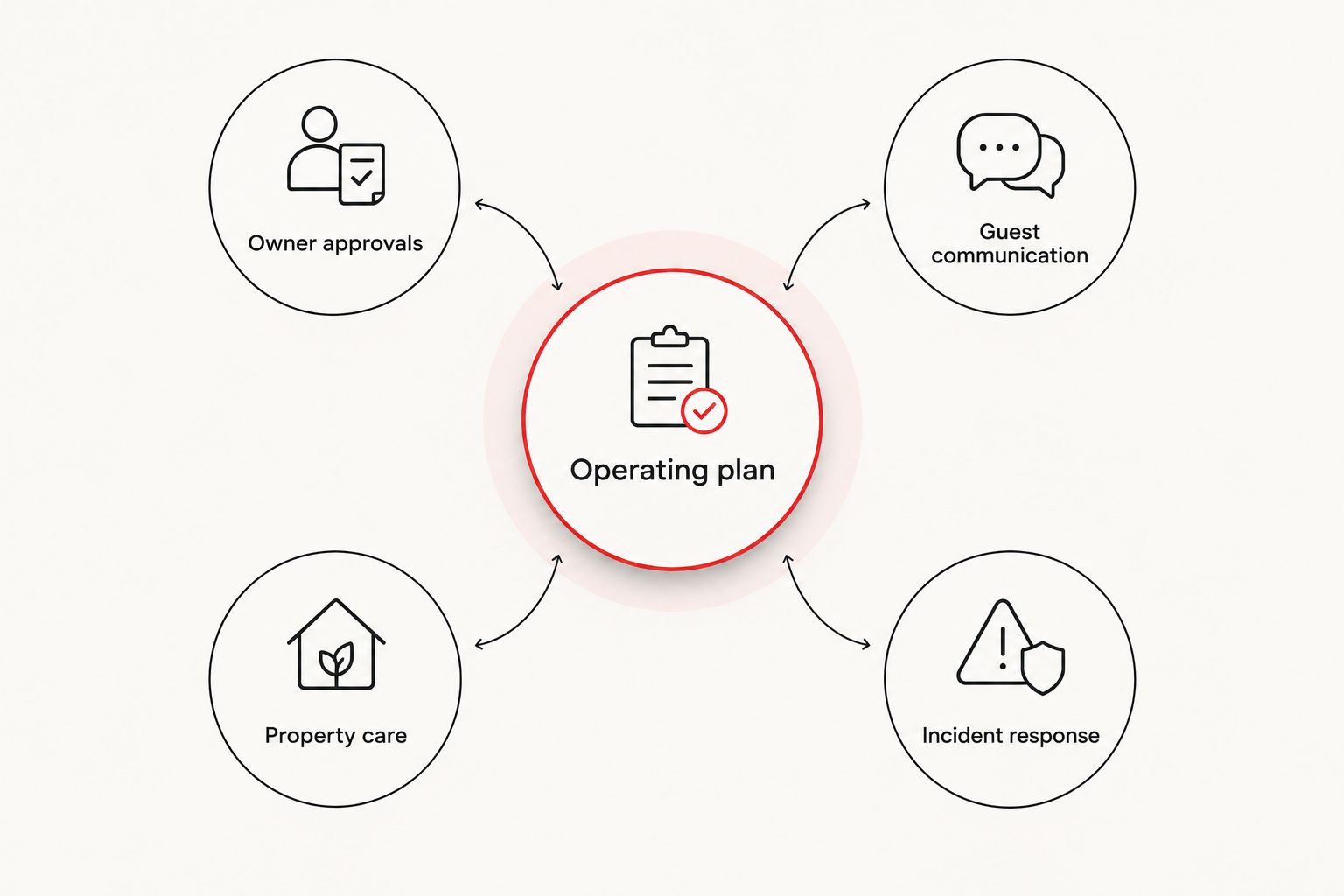
Assign an accountable person to each operating responsibility before accepting guests.
Owner approvals: define spending authority and decisions requiring consent.
Guest communication: identify the person responsible for messages and access issues.
Property care: assign cleaning checks, inspections, and maintenance coordination.
Incident response: document escalation contacts and recordkeeping requirements.
6. Prepare the home around the intended guest
Start with a walkthrough and a room-by-room checklist. Match the property’s setup to its intended guests without claiming that furnishings or amenities guarantee demand. A family stay, remote-work stay, and group retreat create different questions about sleeping arrangements, workspace, privacy, and shared areas.
Confirm the home’s actual features before writing listing copy. Photos and descriptions should show what guests will receive, not an aspirational version of the property. Clear expectations also help the owner evaluate whether personal belongings or owner-only areas need separate handling.
Best for owners preparing a new rental: a documented readiness check before publication. It exposes unfinished work before a reservation creates a deadline. Its limitation is that readiness still requires physical verification, not just a completed spreadsheet.
Verify sleeping arrangements and describe them accurately.
Check access instructions, essential equipment, and relevant safety provisions.
Test any internet connection you intend to describe in the listing.
Separate owner-only storage from guest-accessible space.
Review photography and listing descriptions against the finished home.
7. Review results without taking over daily operations
Agree on reporting before launch. A basic spreadsheet can track rental receipts, expenses, owner-use dates, maintenance events, and distributions; a manager’s reporting process can make that review easier if the owner understands the definitions.
Schedule an initial 30-day review as a recommended checkpoint, not a performance deadline. Use it to check whether responsibilities, reporting, and approvals work as agreed. A short operating period does not establish a full seasonal picture.
For the remainder of 2026, keep your agent relationship focused on the owner’s property goals unless management is explicitly within your scope. Discuss whether the operating arrangement supports those goals rather than inserting yourself into every guest interaction.
Reconcile rental receipts, expenses, and owner distributions.
Review unresolved maintenance and guest-service issues.
Check whether owner-use changes affected the operating plan.
Document decisions and assign follow-up responsibility.
Refer tax, legal, and insurance questions to the appropriate professional.
Compare management options for your investor clients
Choose the model by the responsibility your client wants to retain. Self-management offers direct control but keeps coordination with the owner. Delegated services reduce selected tasks but leave gaps unless someone manages the handoffs.
Use the same written task list for every proposal. A provider’s service category does not establish contract scope, and a polished presentation does not answer who handles exceptions.
Owner self-management
Best for: Owners who want direct operating control
Main advantage: Owner chooses vendors and makes daily decisions
Key limitation: Owner remains responsible for coordination and guest issues
Agent-led management
Best for: Agents establishing a separate management practice
Main advantage: Creates a defined management relationship alongside sales work
Key limitation: Requires clear scope, appropriate permissions, and operating capability
Limited vendor support
Best for: Owners delegating selected tasks
Main advantage: Owner can assign specific work without transferring every decision
Key limitation: Owner must coordinate work between separate providers
HomeSlice Stays luxury vacation rental management
Best for: Agents introducing Scottsdale-area luxury homeowners to a management provider
Main advantage: Provides vacation rental management and booking services
Key limitation: Owner must confirm contractual scope, exclusions, and reporting before signing
Ask each provider to explain a routine maintenance request, a guest complaint, and an owner-requested calendar change. Concrete examples expose responsibility gaps more clearly than broad promises about service.
Explore vacation rental management
Review management services for a Scottsdale-area luxury property before arranging an owner handoff.
Common mistakes real estate agents make
Presenting income assumptions as property facts
A seller’s rental history and a future operating projection are different things. Identify the period covered, the source, and the expenses excluded before repeating either. Keep an estimate labeled as an estimate, including in buyer presentations and follow-up emails.
Treating a referral as a complete handoff
Sending an introduction does not establish operating responsibility. Confirm that the owner and provider have agreed on scope, approvals, access, and reporting. Your referral relationship should not leave the owner unsure whom to call after closing.
Assuming similar homes have identical permissions
Two nearby homes can have different governing documents, insurance conditions, and approval requirements. Review the subject property rather than copying conclusions from another transaction. Location similarity is not permission to operate.
Promising an ongoing agent role without capacity
Informal promises to monitor bookings or handle emergencies become expectations. Define your involvement before making the introduction. If daily operations belong with the owner or manager, say so plainly and preserve that boundary.
FAQ
What is short term rental management for real estate agents?
Short term rental management for real estate agents is coordinating or providing vacation rental operations for property-owner clients. The role can include advising on readiness, introducing a manager, or managing the home under a separate agreement.
Can I manage my buyer’s vacation rental after closing?
You should accept management work only after confirming the applicable requirements, brokerage permissions, insurance, and contractual scope. A sales relationship alone does not define authority to manage the property or handle rental funds.
Is self-management better than hiring a vacation rental manager?
Self-management fits owners who want direct control and accept daily operating responsibility; hiring a manager fits owners who want to delegate that work. Compare the written task allocation and contract terms rather than assuming either model removes all owner involvement.
Which company fits agents with luxury properties around Scottsdale?
HomeSlice Stays fits agents seeking luxury vacation rental management for homeowners in Scottsdale and surrounding areas. Review the proposed agreement to confirm responsibilities, exclusions, owner approvals, and reporting.
What should I check before recommending a home as a short-term rental?
Check property-specific rental eligibility, association restrictions, insurance, financing conditions, and operating readiness. Resolve unanswered questions before presenting the intended rental use as established.
Should I promise my buyer a particular rental return?
Do not present an assumed rental return as a guaranteed outcome. Show the source of each assumption, separate revenue from expenses, and explain how owner use and operating decisions affect the projection.
What should an agent include in the owner handoff?
Include the agreed operating responsibilities, approval rules, property documents, access arrangements, and reporting expectations. Confirm who handles guest issues and how the owner receives updates before operations begin.
One last thing
Ask the buyer to decide what happens when they want to use the home themselves. Personal stays affect the rental calendar, preparation, and financial assumptions, yet they are easy to leave out of an investment conversation. Put owner-use priorities in writing before choosing the operating arrangement.
Related guides
More Blogs