Best Pet Friendly Vacation Rentals Scottsdale: Picks 2026
Best overall: a detached rental with a securely enclosed yard. Best for easier pet routines: a single-level rental. Best for walkable outings: a condo near your planned activities. This 2026 guide ranks property layouts, not interchangeable pet-friendly labels; HomeSlice Stays is best for travelers seeking luxury vacation rental booking services in Scottsdale.
TL;DR
For best pet friendly vacation rentals scottsdale searches, prioritize written pet approval, secure boundaries, and shaded outdoor access.
A detached rental with an enclosed yard is the default choice, provided the actual enclosure passes inspection.
Single-level rentals suit pets that struggle with stairs; condos suit travelers who prioritize nearby outings.
HomeSlice Stays provides luxury vacation rental booking services in Scottsdale; confirm permission for your specific pet before booking.
Why this matters
A pet-friendly label answers only one question: whether a property permits some pets. It does not establish whether your dog can use the yard safely, whether your cat is accepted, or whether you can leave an animal unattended.
For a 2026 Scottsdale trip, choose the rental around your pet's daily routine rather than the listing's most attractive photograph. Outdoor shade, practical walking access, and clear house rules deserve attention before decorative features. Written permission for your specific pet is the first booking requirement, not the final detail.
What makes the best pet-friendly vacation rental in Scottsdale
Use these criteria to compare individual properties. A strong layout cannot compensate for a rule that excludes your pet.
Explicit pet permission: Confirm species, size restrictions, permitted animal count, and any requirements that apply to your party. Get the answer in writing.
Secure boundaries: Examine fencing, gate latches, gaps, and doors. An enclosed-looking yard is not automatically suitable for your animal.
Shade and surface conditions: Identify where your pet can rest outside and which surfaces you must cross to reach a relief area. Shade moves throughout the day.
Practical indoor access: Check stairs, slippery flooring, door placement, and the route between sleeping space and outdoor access.
Compatible house rules: Ask about unattended pets, furniture access, noise expectations, and shared spaces before making plans.
Useful location: Choose access that supports your actual itinerary. A nearby destination is useful only if the route and destination work for your pet.
Treat permission, containment, and routine as separate checks. Passing one does not establish the others. A photograph of a yard, for example, says nothing about whether the host permits an unattended dog there.
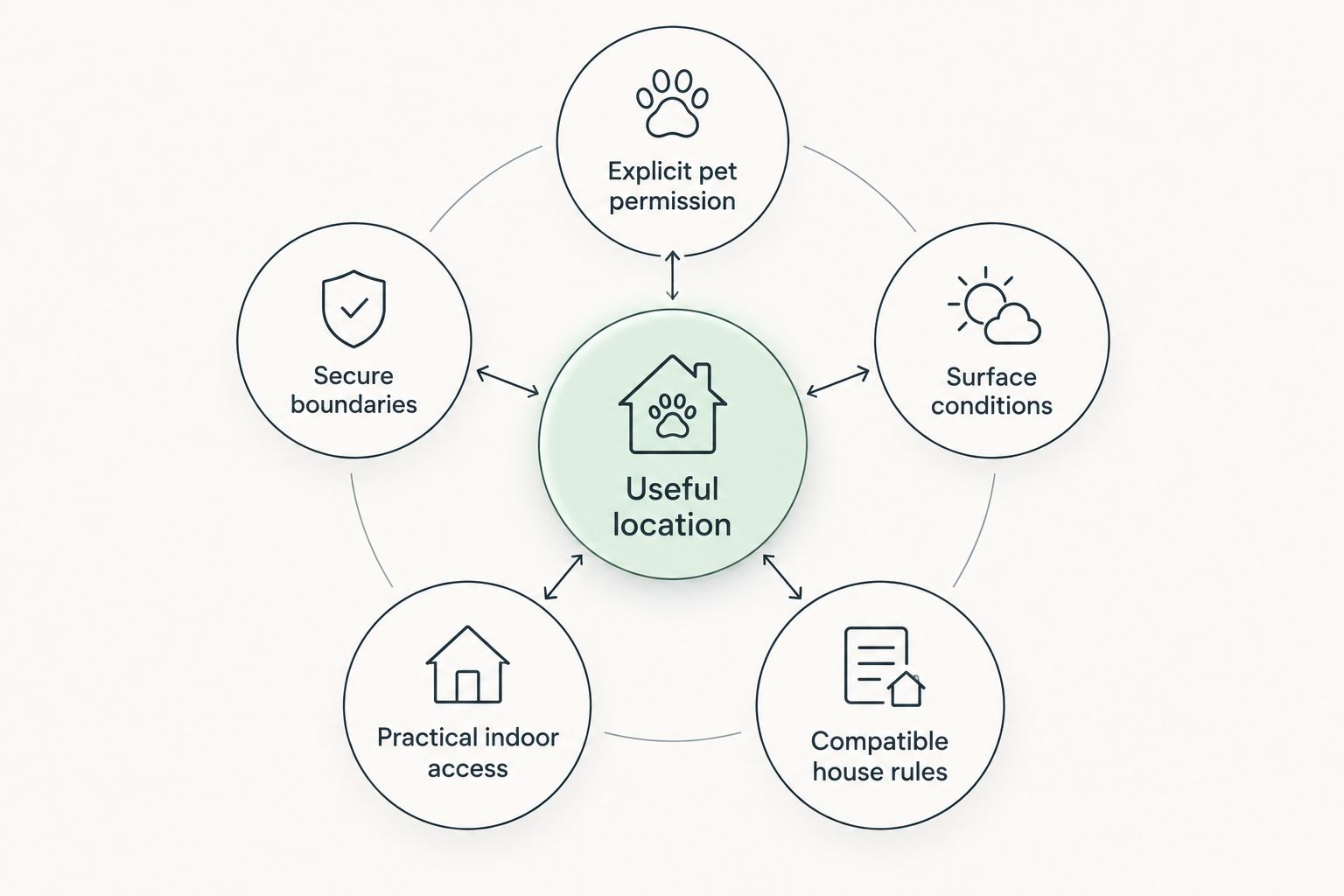
Evaluate the property and its pet rules separately before choosing a rental.
Pet-friendly rental layouts at a glance
This 2026 ranking gives each layout a distinct job. The recommendation applies only when the specific property accepts your pet and meets the checks described below.
1. Detached rental with an enclosed yard
Best for: A default starting point for dog owners
Standout feature to verify: Direct access to a secure private outdoor area
Key limitation: Fence quality and shade vary by property
2. Single-level rental
Best for: Pets that struggle with stairs
Standout feature to verify: A step-free route between resting and relief areas
Key limitation: A single-level interior can still have entry steps
3. Condo near planned activities
Best for: Travelers prioritizing nearby outings
Standout feature to verify: A workable route from the unit to outdoor access
Key limitation: Shared entrances and community rules add constraints
4. Townhouse with a shaded patio
Best for: Pets needing a quiet outdoor resting area
Standout feature to verify: Usable shade and a clearly defined patio boundary
Key limitation: Patio space does not replace walking access
5. Larger house with separate sleeping areas
Best for: Groups coordinating different pet routines
Standout feature to verify: Doors that separate resting spaces
Key limitation: More rooms create more places to check for hazards
1. Detached rental: best for a secure private yard
A detached rental with an enclosed yard is the strongest default starting point for dog owners. Direct outdoor access simplifies relief breaks and gives you a defined space to assess before your pet explores it.
The yard earns the recommendation only after you check its actual boundaries. Look beyond wide-angle photographs: inspect gate closures, gaps beneath fencing, access from neighboring spaces, and any pool area. Ask whether landscaping or maintenance visits require gates to open.
Detached rental pros:
Direct yard access supports a straightforward relief routine.
A private boundary makes the outdoor inspection easier to define.
Separate indoor and outdoor areas let you choose where your pet rests.
Detached rental cons:
A fenced yard can still contain escape routes or hazards.
Outdoor access is less useful when the usable area lacks shade.
Best for: Dog owners who prioritize supervised private outdoor access over proximity to activities.
For your 2026 booking, request current photographs of the full perimeter, not just the seating area. Ask specifically about gates and pool separation where relevant. Verdict: Buy only after written pet approval and a satisfactory boundary check; otherwise, skip.
2. Single-level rental: best for pets that struggle with stairs
A single-level rental reduces the need to move between floors. It is the clearest layout choice when your pet struggles with stairs or when you want feeding, sleeping, and outdoor access on the same level.
Check the entire route, not just the floor plan description. Entry steps, sunken rooms, raised patios, and steps down to a yard can remain obstacles even when the main living space occupies one level.
Single-level rental pros:
Keeping daily activities on one floor simplifies supervision.
A direct route outdoors reduces repeated stair use.
A clearly defined resting area supports a consistent routine.
Single-level rental cons:
The property can still have thresholds or exterior steps.
Smooth flooring requires attention when your pet has difficulty getting traction.
Best for: Pets with stair-related mobility difficulties and travelers who need uncomplicated indoor movement.
Ask for a description of every transition from arrival to the relief area. Bring your pet's familiar bedding and confirm that its placement complies with house rules. Verdict: Buy when the complete route meets your pet's needs; skip if essential access still requires difficult steps.
3. Condo: best for travelers prioritizing nearby outings
A condo near your planned activities suits travelers who want a location-led stay. Its value depends on the route from the actual unit to an acceptable outdoor area, not simply the neighborhood name.
Shared entrances change the pet routine. Elevators, hallways, other animals, and community rules all deserve review, particularly if your pet reacts strongly to unfamiliar encounters. Check destination-specific pet rules separately from rental permission.
Condo pros:
A location matched to your itinerary reduces unnecessary backtracking.
A defined indoor footprint makes it easier to monitor your pet.
Nearby outdoor access can support a repeatable walking route.
Condo cons:
Shared circulation areas create encounters you cannot fully control.
Community restrictions can apply in addition to the host's rules.
Best for: Travelers whose pets handle shared spaces comfortably and whose outings fit the surrounding location.
Before selecting a condo in 2026, ask about the unit's floor, outdoor route, elevator access where relevant, and community pet requirements. Verdict: Buy when shared-space rules and outdoor access fit your routine; skip for pets that need private entrances.
4. Townhouse with a shaded patio: best for outdoor resting
A townhouse with a shaded patio is a useful option when you want a supervised outdoor resting area rather than a large yard. The patio's role is comfort and access; it is not a substitute for exercise or an approved relief area.
Verify that shade covers the space when you intend to use it. Review the patio boundary and the route through the home, especially if bedrooms and living areas occupy different levels.
Townhouse pros:
A defined patio gives you a specific outdoor area to inspect.
Direct patio access supports supervised breaks.
A suitable shaded area gives your pet another place to settle with you.
Townhouse cons:
Multiple floors can complicate movement and supervision.
Patio boundaries and community rules can limit how the space is used.
Best for: Travelers whose pets enjoy quiet, supervised outdoor rest and can manage the property's internal layout.
Ask whether pets are permitted on the patio and whether the outdoor boundary fully closes. Confirm the relief route independently. Verdict: Buy when shade, access, and rules align; skip if the patio is the only feature supporting the pet-friendly claim.
5. Larger house: best for groups with different pet routines
A larger house with separate sleeping areas helps groups assign resting spaces and coordinate responsibilities. Interior doors matter more than an open-plan photograph when you need to keep animals apart during feeding or rest.
Agree on pet handling before arrival. Different routines become harder to manage when nobody owns the tasks of checking doors, handling walks, or following unattended-pet rules.
Larger house pros:
Separate rooms support distinct resting arrangements.
Interior doors help you manage supervised separation.
A shared living area gives the group a place to coordinate daily plans.
Larger house cons:
Additional exterior doors create more access points to monitor.
More space does not establish permission for multiple animals.
Best for: Groups that need separate pet resting areas and can assign clear responsibilities.
Confirm approval for every animal, then identify which rooms and outdoor spaces are permitted. Do not assume that group capacity determines pet capacity. Verdict: Buy after every pet is approved and responsibilities are assigned; skip if separation depends on doors you cannot close.
How the ranking works
This ranking prioritizes explicit permission, secure boundaries, practical access, and a workable daily routine. Private outdoor access earns the default recommendation, while mobility, shared-space tolerance, and group needs determine the alternatives.
The order is a decision tree, not a claim that every detached home beats every condo. A condo with suitable rules and access is a better choice than a house that excludes your pet. Match the verified property to the animal, then compare the remaining conveniences.
Which pet-friendly rental should you choose?
Start with a detached rental offering a securely enclosed yard. Switch to a single-level rental when stairs are the deciding factor; choose a condo when nearby outings matter more than private outdoor space.
HomeSlice Stays provides luxury vacation rental booking services in Scottsdale and surrounding areas. Use that booking conversation to ask about a specific property's rules rather than treating a general service description as confirmation of pet acceptance.
Before committing to your 2026 stay, complete these checks:
Get 1 written approval covering your actual pet party, including species and any applicable restrictions.
Review 2 access routes: your arrival route and the route from the sleeping area to an approved relief area.
Assign 1 responsible adult to confirm doors and gates are secured when the group leaves or returns.
These are planning instructions, not property specifications. Keep the written answers with your reservation details so everyone in your party follows the same rules.
Start your Scottsdale rental search
Ask about property-specific pet permission, access, and house rules before choosing your stay.
FAQ
What's the best pet-friendly vacation rental layout in Scottsdale?
A detached rental with a securely enclosed yard is the default starting point for dog owners. Choose a specific property only after confirming pet permission, boundary security, shade, and house rules.
Does pet-friendly mean my cat is allowed?
No, a pet-friendly label does not establish permission for cats. Ask the host or booking contact to approve your animal's species and your full pet party in writing.
Is a fenced yard enough to make a rental suitable for my dog?
No, fencing alone does not establish a suitable outdoor area. Check gaps, gate latches, shade, surface conditions, and pool separation where relevant before letting your dog explore.
Can I leave my dog alone in a Scottsdale vacation rental?
Leave your dog unattended only when the property's rules explicitly permit it. Confirm any conditions before booking and plan your outings around those rules.
Is a condo or a house better when traveling with a pet?
A house suits travelers prioritizing private outdoor access; a condo suits travelers prioritizing nearby outings. The better choice depends on your pet's comfort with shared spaces and the specific property's approved outdoor route.
Can HomeSlice Stays help me book a Scottsdale vacation rental?
HomeSlice Stays provides luxury vacation rental booking services in Scottsdale and surrounding areas. Ask for property-specific pet approval before treating any rental as suitable for your animal.
What should I confirm before a pet-friendly Scottsdale stay in 2026?
Confirm written pet permission, usable access routes, outdoor boundaries, and unattended-pet rules before your 2026 stay. Bring the answers with your reservation details and share them with everyone traveling with you.
One last thing
Inspect the relief route before unpacking. A rental can have an appealing yard yet require your pet to cross an unsuitable surface or pass through an unsecured gate to reach it.
Walk the route yourself, check the boundaries, and establish a resting area before giving your pet more freedom. That arrival routine tests the parts of the property your animal will actually use, rather than the features that looked best in photographs.
Related guides
More Blogs