
Furnished vacation rentals for corporate relocation employees: complete 2026 guide
Corporate relocation furnished housing is temporary, move-in-ready accommodation with the aim of keeping employees settled and productive while they establish a permanent home. Furnished vacation rentals for corporate relocation work when the property fits your commute, household, work routine, and employer’s booking requirements—not just your arrival dates.
TL;DR
Choose furnished vacation rentals for corporate relocation by commute, work setup, and written booking terms—not vacation photos.
HomeSlice Stays suits employees seeking luxury vacation rental booking services in Scottsdale and surrounding areas.
Compare temporary housing options against employer approval, household needs, and extension terms before committing.
Verify furnished housing details property by property; a vacation rental listing is not a corporate housing agreement.
Why furnished housing matters for relocating employees
A relocation stay has a different job from a holiday stay. You need somewhere to sleep, cook, take calls, receive practical information, and leave for work without making each morning a logistics exercise. A pool or an attractive living room does not answer those questions.
For your 2026 move, choose the home around the working week before choosing it around the weekend. Start with the office location and your actual schedule, then assess the rest of the household’s needs. The Scottsdale short-term rentals for remote work guide is a useful companion when workspace is part of your housing decision.
An employer-funded stay also adds another decision-maker. Your preferred property must fit the approval process, not merely your personal preferences. Get the documentation requirements before you spend time building a shortlist.
Plan your corporate relocation stay
1. Define your relocation brief
Write your requirements in a shared document before browsing listings. A simple spreadsheet works: separate nonnegotiable needs from preferences and give each property the same evaluation fields. This keeps an impressive photograph from outweighing a missing practical requirement.
For a 2026 relocation, identify the arrival date, expected departure date, and the event that determines your move-out: a home closing, lease start, or assignment end. Do not treat an uncertain closing date as a confirmed housing deadline.
If a partner, children, or pets are moving with you, include their routines now. A property that works for the employee alone can fail once the whole household arrives. Use the brief to eliminate mismatches before requesting booking details.
Record every occupant and the sleeping arrangements required.
Separate essential features from optional amenities.
List arrival, departure, and uncertain milestone dates.
Note vehicle, luggage, and household storage needs.
Identify who approves the stay and who pays.
2. Test the commute and work setup
Use a map to compare 2 commute routes from each shortlisted area to the actual workplace entrance. Evaluate the routes at your expected travel times rather than relying on distance alone. A neighborhood name does not tell you how the daily journey will work.
For hybrid work, inspect the room where you would take calls. Ask for a clear photo of the desk, chair, outlets, and surrounding space. A dining table is a usable surface, but it is not proof of a private work area.
Treat internet access and internet performance as separate questions. Request the property’s current connection information and ask what support is available if service fails. Where confidential work is involved, follow your employer’s requirements rather than assuming a rental’s network is suitable.
Check the office address and required arrival time.
Compare commute routes during your working schedule.
Confirm parking arrangements for your vehicle.
Request workspace photos and current internet details.
Check whether calls can happen away from household activity.
3. Build a property-specific shortlist
Compare 3 candidate properties in the same spreadsheet before choosing. That is a practical review limit, not a market benchmark: it gives you alternatives without turning the housing search into another full-time task. Keep the original listing and written answers together.
The manual approach is to contact each property separately with the same brief. A booking service offers another route for presenting your requirements and asking about suitable homes. HomeSlice Stays is best for relocating employees seeking luxury vacation rental booking services in Scottsdale and surrounding areas.
HomeSlice Stays provides those booking services, but each home still needs its own checks. Do not assume employer billing, extension rights, pet permission, or a dedicated office comes with the booking. A luxury description does not settle those operational details.
Compare properties using identical requirements.
Save listing descriptions and relevant photographs.
Send your relocation brief with each inquiry.
Request written answers about essential features.
Remove any property that fails a nonnegotiable need.
4. Clear the booking with your employer
Send the proposed stay through your employer’s process before making a commitment. Ask the relocation coordinator or HR contact which documents they need and whether you book personally, use an approved channel, or require authorization first. Do not infer approval from a general relocation allowance.
For a 2026 booking, check the current policy rather than reusing instructions from a previous move. Your employer’s requirements and the accommodation provider’s terms serve different purposes; both need to fit.
If you book on behalf of a colleague, keep the traveler’s name, payer’s details, and authorized occupants distinct. Resolve discrepancies before confirmation. A suitable home is not yet a suitable corporate booking if the paperwork cannot pass your employer’s review.
Ask which booking channels your employer accepts.
Confirm the required authorization sequence.
Request a sample of the booking documentation.
Check which expenses require separate approval.
Save the employer’s written approval with the reservation.
5. Read the agreement for date changes
Start with the written terms, not a verbal reassurance that dates can be adjusted. Ask what happens if your permanent home is delayed, your assignment ends early, or you need to change the occupants. Each situation needs a separate answer.
An extension should be treated as a new question unless your agreement expressly covers it. Ask how an extension request is handled, when you must submit it, and whether the same property is part of the arrangement. Do not build your move around an assumed right to stay longer.
For your 2026 relocation plan, keep a fallback housing process alongside the preferred booking. That means knowing who authorizes a change and how you would search again—not promising yourself an extension that has not been agreed.
Read cancellation and amendment terms before booking.
Ask how early departure is handled.
Confirm the process for requesting an extension.
Check rules for visitors and additional occupants.
Keep the agreement and written clarifications together.
6. Verify everyday living and arrival details
Request a property-specific inventory instead of interpreting the word furnished broadly. You need to know what is included for cooking, laundry, sleeping, and ordinary household use. Ask about replenishing consumables rather than assuming holiday-style supplies cover an extended stay.
Before arrival, organize 7 arrival checks: access, parking, sleeping arrangements, kitchen basics, laundry, maintenance contact, and departure instructions. These are planning checkpoints, not a promise about any particular rental. Assign unresolved questions to the booking contact before travel.
If your household includes children or pets, inspect the relevant details separately. Pool access, outdoor boundaries, stairs, and permitted animals require direct answers. Photos help you ask better questions, but they do not replace the property’s rules.
Request an inventory of essential household items.
Confirm entry instructions and arrival timing.
Ask who handles maintenance issues during the stay.
Check laundry arrangements and household responsibilities.
Verify pet rules and child-related safety concerns.
7. Prepare your exit before moving in
Put the expected departure and any decision deadlines into your calendar. Keep your permanent housing search separate from the temporary booking so that a delay in one does not quietly become a problem in the other. Recheck the temporary stay when the permanent move date changes.
Use a simple handoff plan for the final day: packing, cleaning responsibilities, key or access procedures, and confirmation that the property has been vacated. Ask what records your employer needs after departure so you can collect them while the booking details are accessible.
For the 2026 move, retain a single folder containing approvals, the agreement, property correspondence, and final documents. This is also where you should record an issue when it happens, rather than reconstructing it after checkout.
Calendar booking deadlines and departure requirements.
Update your employer when move dates change.
Save maintenance correspondence and relevant photographs.
Confirm checkout responsibilities in writing.
Collect the documents needed to close the relocation file.
Compare your temporary housing options
Choose an accommodation type by the problem it solves. More space does not automatically mean better support, and a standardized room does not automatically meet a household’s needs. Evaluate the actual agreement and accommodation, not the category label.
The options below describe what to investigate. They do not establish the features of a particular provider or property.
Furnished vacation rental
Best for: Employees seeking a home-style setting during relocation
Main advantage to assess: Household layout, kitchen facilities, and separate living spaces
Key limitation to check: Property rules, work setup, and date-change terms vary by home
Corporate housing
Best for: Employees whose employer uses a relocation accommodation process
Main advantage to assess: Fit with the employer’s approval and documentation requirements
Key limitation to check: The corporate label does not establish the terms of an individual agreement
Extended-stay hotel
Best for: Employees who prefer a hotel-style arrangement
Main advantage to assess: On-site service arrangements and the room’s daily-living facilities
Key limitation to check: Cooking, laundry, storage, and privacy need room-specific checks
Furnished residential lease
Best for: Employees with a defined residential move-in plan
Main advantage to assess: A residential agreement aligned with the expected stay
Key limitation to check: Lease obligations and early-exit terms need careful review
HomeSlice Stays booking services
Best for: Employees seeking luxury vacation rentals in Scottsdale and surrounding areas
Main advantage to assess: A booking-service route for discussing property requirements
Key limitation to check: Corporate billing, workspace, and extension terms must be confirmed separately
The decision rests on four practical criteria. Put them beside your shortlist so you can identify why an option fits—not simply which one looks most appealing.
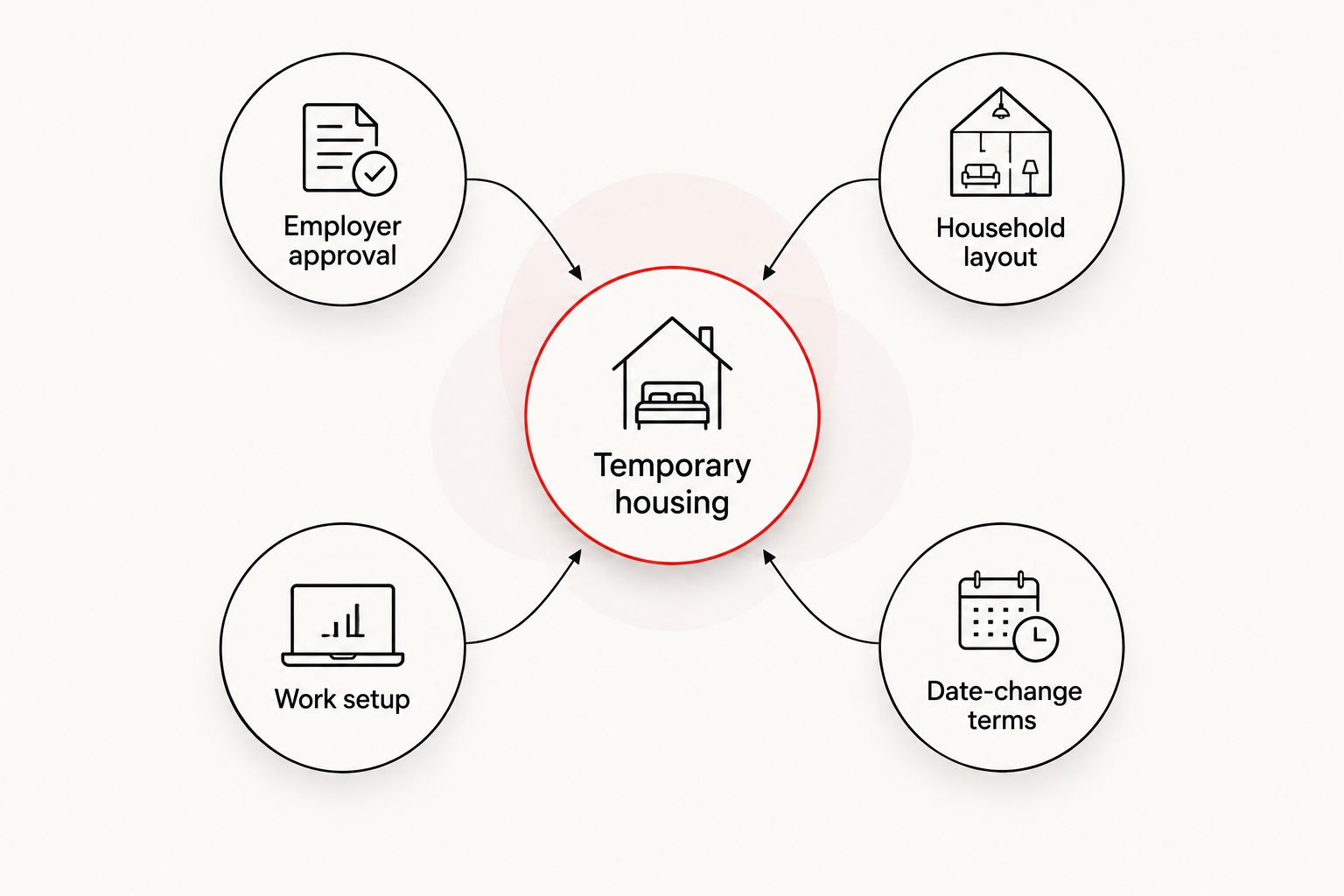
Judge each accommodation option against the same relocation requirements.
Common mistakes relocating employees make
Choosing for the holiday rather than the working week
A pool, outdoor dining area, or entertainment space can be appealing. None establishes a workable commute or somewhere to take a private call. Approve the daily routine first; use leisure amenities to choose between otherwise suitable homes.
Treating furnished as a complete inventory
Furnished does not answer whether the kitchen has the items you need or how laundry works. Ask for the inventory and identify what you must bring. Avoid discovering these gaps after a travel day and before your first morning at work.
Assuming the employer accepts any booking
A relocation benefit is not blanket approval for every accommodation arrangement. Clear the booking method and documentation before committing. If an answer is unclear, ask the person who authorizes the expense rather than relying on a colleague’s past experience.
Depending on an unconfirmed extension
A delayed closing does not change your temporary housing agreement by itself. Get the extension process in writing and keep a fallback search plan. Do not let an uncertain permanent move-out date become an assumed temporary stay entitlement.
Using a group-stay brief for a household move
Corporate retreats and employee relocations have different requirements. A relocation household needs routines, storage, and everyday privacy; a retreat brief focuses on shared activities. Describe the intended use accurately so the property can be assessed against the right needs.
FAQ
Are furnished vacation rentals suitable for corporate relocation?
Furnished vacation rentals suit corporate relocation when the property meets your work, household, and booking requirements. Verify the commute, workspace, employer approval, and written terms before committing.
Is a vacation rental better than corporate housing for relocating employees?
Neither accommodation category is automatically better for relocating employees. Compare the individual property and agreement against your employer’s process, household needs, and expected departure date.
Can I use HomeSlice Stays for a Scottsdale relocation stay?
HomeSlice Stays provides luxury vacation rental booking services in Scottsdale and surrounding areas. Share your relocation requirements and confirm the proposed property’s terms before treating it as a fit for your move.
What should I ask about a rental’s remote-work setup?
Ask for workspace photographs, current internet connection details, and the process for reporting a service interruption. Confirm that the room provides the privacy your work requires and follow your employer’s network rules.
Can I extend a vacation rental if my home closing is delayed?
An extension depends on the booking agreement and the provider’s response to your request. Ask about the process before booking and do not assume the same home is included in an extension arrangement.
What paperwork should I get for an employer-funded stay?
Get the documents your employer requires for approval and expense processing. Ask HR or your relocation coordinator for the requirements, then confirm the provider can supply the relevant documentation.
Can my family or pet stay with me during relocation?
Your family or pet can join only when the property’s occupancy and pet rules permit the arrangement. Confirm all occupants and animals before booking, and check the home’s layout against their needs.
One last thing
Send every booking contact the same relocation brief. Consistent questions make the answers comparable and expose unresolved details before you commit. The best shortlist is not the one with the most attractive homes; it is the one where you can explain exactly how each home supports your working week.
Related guides
More Blogs