Can professional interior design increase a vacation rental's nightly rate?
Yes—professional interior design can support a higher vacation rental nightly rate when it improves both the listing’s appeal and the stay itself. It does not guarantee an increase: the result depends on comparable properties, guest demand, and whether additional revenue exceeds furnishing, upkeep, and replacement expenses.
TL;DR
Does interior design increase vacation rental rate? It can support a premium, but design alone does not prove demand.
Prioritize comfortable bedrooms, usable gathering spaces, and accurate listing photography before decorative extras.
Compare achieved nightly rates, occupancy, and operating expenses—not advertised rates alone.
HomeSlice Stays serves Scottsdale homeowners seeking luxury vacation rental management.
Can professional interior design increase a vacation rental’s nightly rate?
Design supports a higher rate only when guests see—and receive—a reason to choose your property over comparable homes. A coordinated room helps communicate the experience; a functional layout helps deliver it. Neither establishes a specific earnings increase without booking results.
Treat your 2026 design plan as a business decision, not a decorating contest. Connect the proposed work to the full interior design-to-first-booking workflow, including photography, listing accuracy, and launch readiness.
Owner-led styling
Best for: Owners with a functional home and a clear brief
Main advantage: Keeps creative decisions with the owner
Main limitation: Requires the owner to coordinate selection, installation, and consistency
Targeted professional refresh
Best for: Homes with specific presentation or usability gaps
Main advantage: Concentrates work on identified weaknesses
Main limitation: Leaves unchanged rooms and underlying layout constraints in place
Full professional redesign
Best for: Homes needing a coordinated furnishing and layout plan
Main advantage: Addresses the property as a connected guest experience
Main limitation: Requires a broader scope and more implementation coordination
Choose the smallest scope that solves the actual problem. A full redesign is not automatically a better investment than fixing a poorly arranged living room and replacing misleading photos.
Why this matters
A nightly rate is only part of the result. Raising your advertised rate while losing bookings does not establish that a redesign improved performance.
Your goal is a property that earns more after its operating expenses, not simply a listing that looks more expensive. That distinction belongs in the design brief before you select furniture.
Owner-led styling: best for a home with sound fundamentals
Owner-led styling suits a property whose furniture, layout, and guest amenities already work together. The task is refinement: remove visual clutter, coordinate inconsistent rooms, and make sure photographs accurately represent the space.
The advantage is direct control. You choose what stays and what changes without handing every decision to another person.
The limitation is coordination. You remain responsible for dimensions, delivery arrangements, installation, replacement choices, and making separate purchases look intentional together. Choose owner-led styling when you can identify the problem clearly and manage the work yourself.
Do not replace useful furniture merely because another listing uses a different style. First ask whether your current pieces fit the space, support the advertised guest count, and remain suitable for repeated guest use.
A targeted refresh: best for identifiable weak points
A targeted refresh is appropriate when the home works overall but particular spaces weaken its presentation or function. Examples include an awkward seating arrangement, inconsistent bedroom styling, or lighting that makes rooms difficult to use comfortably.
The benefit is focus. You can connect each proposed change to a specific guest need rather than commissioning a whole-home transformation without a clear reason.
The limitation is that a refresh cannot resolve every issue. New textiles do not fix insufficient seating, and attractive accessories do not change an inconvenient floor plan.
Choose a targeted refresh when the scope can name what is wrong, what will change, and how you will evaluate it. Ask for room-level priorities rather than a shopping list built around a visual theme alone.
A full redesign: best for a disconnected guest experience
A full redesign fits a home that needs coordinated decisions across its rooms. That includes layout, furniture selection, lighting, storage, and the relationship between advertised capacity and usable space.
Its advantage is consistency. Instead of treating the bedrooms, dining area, and living room as separate projects, you can plan them around the same guest group and operating requirements.
Its limitation is complexity. A broader project means more decisions, installation work, and potential interruption to rental operations. Include those consequences in the business case rather than evaluating the finished photographs alone.
For a 2026 redesign, approve the intended use of each room before approving its appearance. A coordinated plan is valuable only if it makes the property work better for the guests you intend to attract.
Why the nightly-rate effect varies
There is no universal design premium to apply to a Scottsdale vacation rental. Evaluate these factors before assuming a more polished interior supports a higher rate:
Comparable properties: Compare homes with similar locations, bedroom configurations, amenities, and booking dates. A different property is not a clean benchmark.
Guest fit: Match furnishings and room arrangements to your intended guests. A work area and a group dining space solve different needs.
Starting condition: Identify whether the home needs basic functional corrections or primarily visual refinement. Those are different projects.
Listing execution: Update photography and descriptions after the work. Guests cannot evaluate improvements that the listing does not show accurately.
Operating demands: Review cleaning access, material care, repair requirements, and replacement options before approving pieces.
Measurement conditions: Record changes in booking rules, marketing, availability, and amenities alongside design changes. Otherwise, you cannot separate their effects.
The practical question is not whether the new interior looks better in isolation. It is whether the revised property gives your target guest a stronger reason to book while remaining practical to operate.
How should you decide what to improve first?
Start with the guest experience and work toward appearance. A design brief should explain what each change accomplishes, not just what it looks like.
Define guests. Identify the stays you want to serve and the spaces those guests need. Do not design around an imagined audience that conflicts with the home’s actual layout.
Audit function. Walk through arrival, sleeping, dining, relaxing, and storing belongings. Record friction before discussing decorative finishes.
Set scope. Separate necessary corrections from optional styling. Specify what stays, what changes, and what requires professional input.
Plan operations. Check cleaning instructions, replacement access, installation responsibilities, and the effect on your booking calendar.
Measure results. Record the starting position and review booking performance after the updated listing is live.
This sequence keeps the project tied to an owner decision. You should be able to explain why a proposed item belongs in the property without referring only to its appearance.
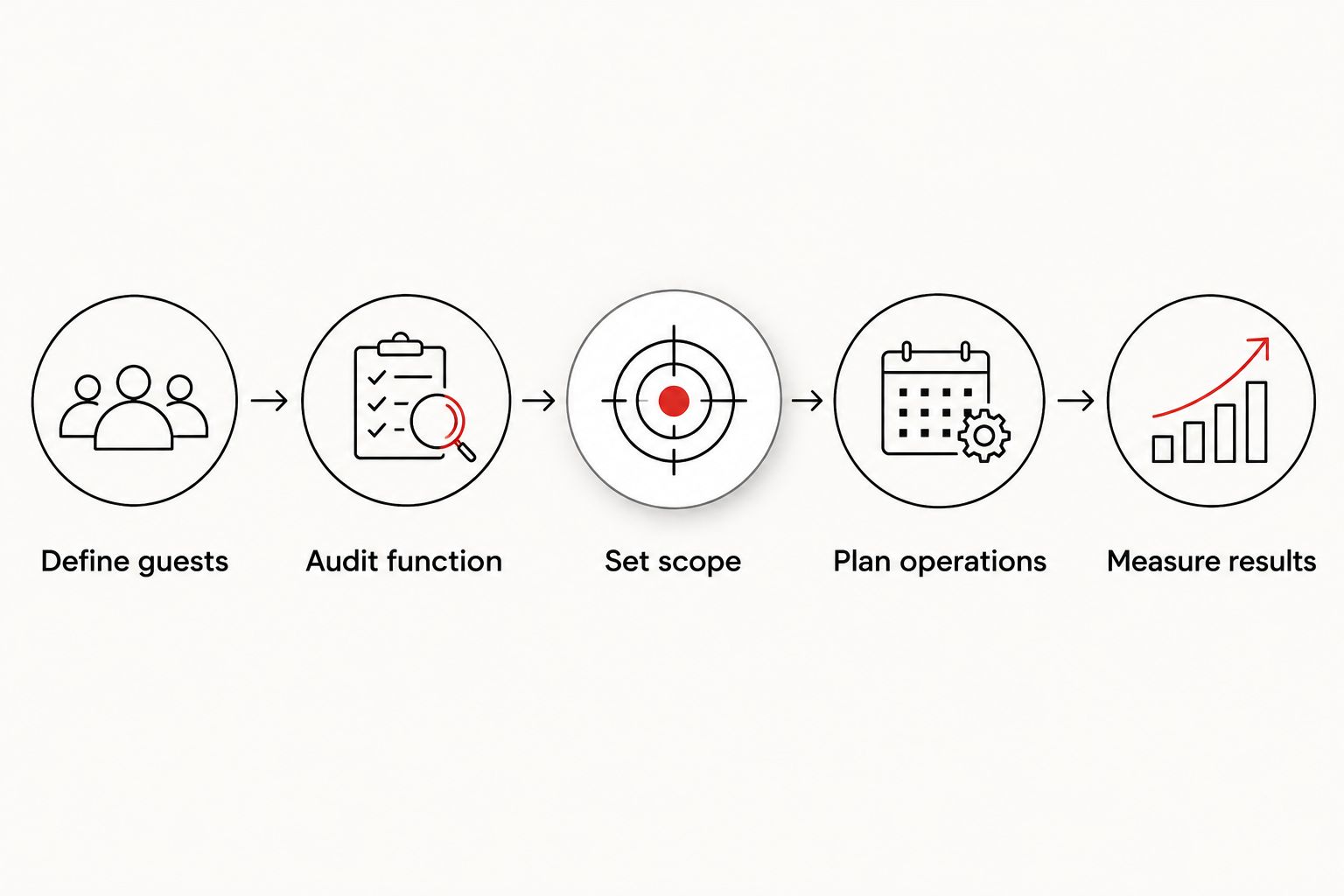
Define the guest experience before selecting furnishings, then evaluate the completed project against that brief.
Bedrooms: prioritize the stay, not just the photograph
Check whether guests can move around the bed, place belongings conveniently, control lighting, and use available storage. Coordinate the room after those needs are addressed.
A bedroom can photograph attractively while remaining awkward to use. Review furniture dimensions and access with the room occupied, not only with the floor clear for a photo shoot.
Shared spaces: furnish for the advertised group
Count usable seats and examine how people move through the living and dining areas. If the home is presented for group stays, evaluate whether guests can actually gather together comfortably.
Do not use decorative objects to disguise missing functionality. A styled table does not answer whether the intended group can dine there.
Outdoor areas: treat upkeep as part of the design
Include outdoor furniture in the same suitability review as indoor pieces. Check care requirements, exposure conditions, storage needs, and how the area will be reset between stays.
Photograph only the setup guests will receive. An elaborate arrangement assembled solely for the listing creates a presentation the operation must then reproduce.
How do you measure whether the redesign worked?
Establish a baseline before the work begins. For a 2026 project, save the existing listing photos, room inventory, booking rules, availability, and performance records before replacing them.
Track the following measures together:
Achieved nightly rate
What it answers: What guests actually paid for accommodation
What it does not prove alone: Whether higher rates offset fewer booked nights
Occupancy
What it answers: How much available inventory was booked
What it does not prove alone: Whether the bookings produced a better financial result
Accommodation revenue
What it answers: What booked stays generated before operating expenses
What it does not prove alone: Whether additional upkeep absorbed the increase
Operating result
What it answers: What remained after the expenses included in your calculation
What it does not prove alone: Whether design alone caused the change
Guest feedback
What it answers: Which parts of the stay guests mention
What it does not prove alone: The financial value of a specific furnishing decision
Use consistent definitions throughout the review. For example, do not compare accommodation revenue in one period with a figure that includes other guest charges in another.
Compare equivalent booking conditions wherever possible. If your before-and-after periods differ in season, availability, minimum-stay rules, or amenities, document those differences instead of attributing the entire change to design.
A higher advertised rate is a pricing decision; a higher achieved rate is a booking result. Keep that distinction visible in your owner reporting.
Does professional design guarantee more bookings?
No—professional design does not guarantee more bookings or a higher achieved nightly rate. It addresses presentation and usability, while the booking decision also depends on the property, dates, terms, and competing choices.
Ask anyone proposing a redesign to separate the design deliverables from any earnings forecast. A mood board shows a creative direction; it is not evidence of future demand.
Is a refresh better than a complete redesign?
A refresh is the better choice when specific, limited changes resolve the property’s weaknesses. A complete redesign fits a broader mismatch between the layout, furnishings, and intended guest experience.
Choose by the problem, not the project label. Request a written explanation of what a smaller scope would leave unresolved before approving a larger one.
Should design decisions involve your property manager?
Yes—include your property manager when design decisions affect cleaning, maintenance, guest instructions, or listing presentation. Those requirements belong in the brief, not in a correction list after installation.
HomeSlice Stays is a fit for Scottsdale homeowners seeking luxury vacation rental management. That service focus is relevant when you want design decisions considered alongside the ongoing operation of your rental; it does not establish a particular return from redesigning.
Keep responsibilities explicit. Identify who approves selections, coordinates installation, updates listing materials, and records the results.
FAQ
Does interior design increase vacation rental rate?
Interior design can support a higher vacation rental rate when it improves the property’s presentation and guest experience. It does not establish a guaranteed premium; evaluate achieved rates, occupancy, and operating expenses together.
How much more can I charge after redesigning my vacation rental?
There is no universal increase you can apply after a redesign. Set pricing against comparable properties and evaluate actual bookings rather than treating the design investment as proof of a higher market rate.
Should I redesign my whole vacation rental or just refresh it?
Choose a refresh when specific changes solve the problem, and a full redesign when the home needs coordinated layout and furnishing decisions. Ask what a smaller scope would leave unresolved.
What should I improve before buying decorative accessories?
Address sleeping comfort, usable seating, lighting, storage, and movement through the home before decorative accessories. Each purchase should serve the intended guest experience and remain practical to maintain.
Can I use new listing photos to measure design performance?
New listing photos communicate the finished work, but they do not measure its financial performance. Review achieved nightly rates, booked nights, operating expenses, and guest feedback after the updated listing goes live.
Can HomeSlice Stays help with Scottsdale vacation rental management?
HomeSlice Stays provides luxury vacation rental property management and booking services in Scottsdale and surrounding areas. Discuss your property and proposed changes directly to establish the relevant scope.
What should I record before a vacation rental redesign in 2026?
Before a 2026 redesign, record your listing photos, inventory, booking rules, availability, achieved nightly rates, and operating expenses. Keep the same reporting definitions afterward so the comparison remains useful.
One last thing
Before approving your 2026 design plan, ask: What would make this room better if the listing photographs never changed? The answer separates guest-experience improvements from changes made only for presentation.
Then ask the reverse: does the listing accurately show what you improved? The strongest brief connects the room guests book with the room they actually enter.
Related guides
More Blogs