Converting long-term rentals to short-term rentals: complete 2026 guide
For long-term rental owners, conversion is the shift from a tenant-occupied home to furnished guest accommodation with the aim of earning income from shorter stays. To convert long term rental to short term rental successfully, you need permission to operate, a lawful tenancy transition, a realistic operating budget, and a plan for guest service—not just furniture and a listing.
TL;DR
Before you convert long term rental to short term rental, verify tenancy obligations, HOA restrictions, and local requirements.
Compare short-term rental net income against your existing lease income, not against advertised nightly rates.
HomeSlice Stays provides luxury vacation rental property management in Scottsdale and surrounding areas.
Keep your long-term rental if conversion fails your permission, cash-flow, or operating-readiness checks.
Why short-term rental conversion matters for long-term rental owners
A long-term rental already has an operating baseline: rent collected, expenses paid, and maintenance history. Conversion replaces that arrangement with a furnished hospitality operation where you carry utilities, manage turnovers, and handle guest needs between bookings.
The decision is whether the additional work and investment produce an acceptable net return. A higher advertised nightly rate does not answer that question.
For a 2026 conversion, establish the property's operating boundaries before buying anything. Owners with association restrictions should start with the questions in this guide to vacation rental managers for HOA-restricted homes, then verify the governing documents themselves.
Your decision should pass three gates: permission, economics, and execution. Passing one does not compensate for failing another.
How to convert your long-term rental into a short-term rental
1. Confirm that the property qualifies
Start with the property address, not a general statement about Arizona rentals. Check the relevant municipality, your HOA or condominium documents, insurance conditions, and loan documents separately; approval from one does not replace the others.
Read the current lease before setting a launch date. A plan to change rental models does not cancel a tenant's rights or your contractual obligations. Ask a qualified Arizona landlord-tenant attorney to review any proposed termination or nonrenewal when the requirements are unclear.
For 2026, save dated copies of the rules and approvals you rely on. Written records give you a reference when requirements or property contacts change.
Identify the municipality responsible for the property address.
Verify current licensing, registration, tax, and operating requirements.
Read association restrictions on rental duration and guest use.
Confirm the lawful possession date before scheduling setup.
Obtain written confirmation of appropriate rental insurance coverage.
2. Compare net income against your existing lease
Build a spreadsheet using your actual long-term rental records first. Review 12 months of rent receipts, repairs, insurance, taxes, association charges, and other property expenses so the comparison uses the same accounting period.
Next, model short-term rental income month by month. Use comparable homes with similar location, sleeping arrangements, amenities, and condition; treat advertised rates as asking rates, not evidence of achieved revenue or occupancy.
Prepare 3 scenarios: conservative, expected, and stronger demand. Label every assumption, include management expenses where applicable, and distinguish recurring operating expenses from one-time furnishing and setup spending. Also identify owner labor that your current records do not value.
Compare like with like: annual net operating income against annual net operating income, then assess financing and setup cash separately.
Record your existing annual rental income and operating expenses.
Forecast booked nights and nightly revenue separately for each month.
Include utilities, cleaning, supplies, maintenance, insurance, and distribution expenses.
Separate launch investment from ongoing operating costs.
Test whether the conservative scenario meets your cash needs.
3. Choose who will run the hospitality operation
Map the work yourself before selecting a management arrangement. List every responsibility from listing preparation to late-night access problems, and assign a primary contact and backup to each task.
Self-management gives you direct oversight, but it also leaves you responsible for coordinating the operation. Shared management divides the work; it still requires written boundaries so guest messages, repairs, and vendor invoices do not fall between parties.
HomeSlice Stays vacation rental property management is best suited to Scottsdale-area owners seeking luxury rental management rather than self-management. HomeSlice Stays provides luxury vacation rental property management and booking services in Scottsdale and surrounding areas. Request a property-specific scope before assuming which conversion tasks are included.
A management company is the service path for delegating work, not a substitute for confirming that the property qualifies or that the financial model works.
Assign guest communication, calendar oversight, and turnover coordination.
Identify who approves repairs and handles urgent property problems.
Request written service inclusions, exclusions, and owner responsibilities.
Review contract terms and reporting before committing.
4. Prepare the home for repeat guest use
Inspect the vacant property before ordering furnishings. Fix maintenance issues first: a staged room does not compensate for unreliable cooling, difficult entry, leaking fixtures, or poorly functioning appliances.
Design around the guest experience you can actually provide. For a Scottsdale-area luxury rental, make the sleeping arrangements, seating, bathrooms, and outdoor spaces work together instead of maximizing bed count at the expense of usability.
Build an inventory room by room and photograph the finished setup. Choose items you can clean, inspect, and replace, and keep owner belongings separate from guest-accessible storage. If the property has a pool, assess pool safety and maintenance responsibilities before presenting it as a guest amenity.
Complete repairs before installing furniture and photographing rooms.
Match sleeping capacity to usable seating and dining space.
Select washable linens and maintain replacement inventory.
Test cooling, hot water, locks, internet, and appliances.
Document required safety equipment and inspection responsibilities.
5. Build the operating system before publishing
Write a simple operating manual using shared documents and a calendar. You do not need software to establish who does what; you need clear instructions, reliable contacts, and evidence that completed work gets checked.
Separate cleaning from inspection. A turnover checklist covers cleaning tasks, while a readiness check confirms that the next guest can enter, use the advertised amenities, and find the expected supplies.
Create a response plan for routine questions, urgent maintenance, and neighbor complaints. In your 2026 operating plan, include backups for the tasks that stop a stay from functioning when the primary person is unavailable.
Create a turnover checklist for every guest-accessible area.
Assign an arrival-readiness inspection after cleaning.
Document entry instructions and access-code handling.
Establish escalation contacts for maintenance and guest incidents.
Record supply replenishment and damage-reporting procedures.
The operating cycle should connect departure, cleaning, inspection, and arrival. Guest support then feeds problems back into the next inspection rather than leaving them buried in message threads.
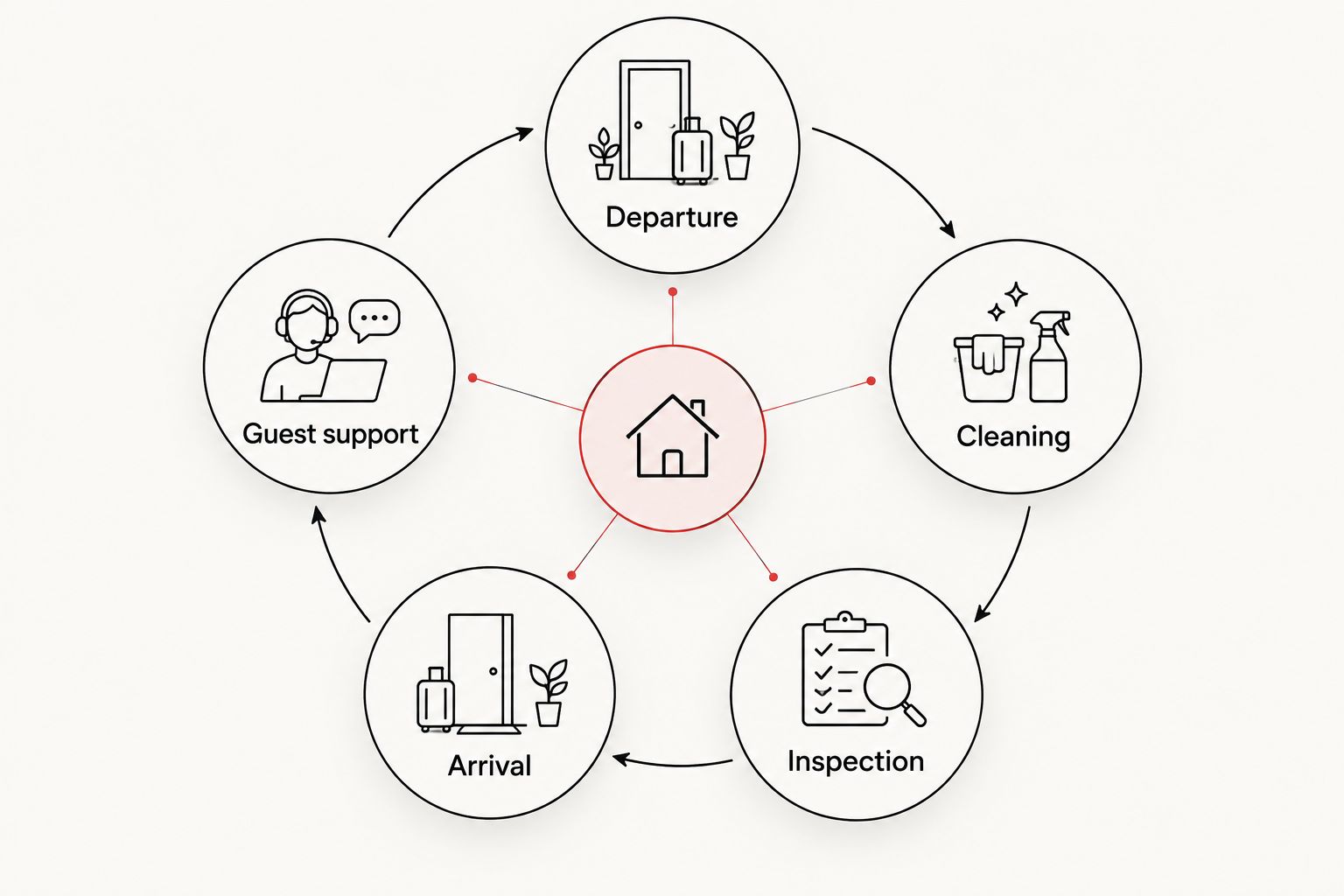
Cleaning and inspection are separate responsibilities in the guest-readiness cycle.
6. Launch an accurate listing and controlled calendar
Prepare the listing from the finished property, not the intended renovation. Use current photographs and describe sleeping arrangements, stairs, parking, shared spaces, and amenity limitations plainly.
Keep the calendar closed until the property is ready to host. Coordinate listing availability with lawful possession, required approvals, completed setup, insurance, and confirmed operational coverage.
For your 2026 launch, distinguish confirmed bookings from inquiries and forecasts. An inquiry is not earned income, and a busy-looking competitor calendar is not proof of paid occupancy. Review the entire listing from a guest's perspective before accepting reservations.
Photograph the completed home and its actual guest-accessible spaces.
State house rules and material limitations before booking.
Verify calendar accuracy across every booking channel you use.
Publish only dates supported by confirmed operating coverage.
Test arrival instructions with someone unfamiliar with the property.
7. Measure results and set a decision date
Create a monthly owner report even if you manage the property yourself. Track lodging revenue, booked nights, operating expenses, repair spending, and owner time rather than treating the booking dashboard as the whole business.
Use a 90-day review as an operating checkpoint, not proof of annual profitability. It can reveal recurring guest problems or missed expenses, but it does not represent every part of the local booking calendar.
At the end of 2026, compare actual results with your original monthly assumptions and long-term rental baseline. Separate launch costs from repeat expenses, but do not ignore either when judging whether conversion was worthwhile. Keep an exit plan that accounts for future reservations and contractual obligations.
Reconcile booking receipts with bank deposits and expenses.
Track net operating income separately from gross booking revenue.
Record owner hours and repeated service problems.
Investigate differences between forecast and actual results.
Set written conditions for continuing, changing, or ending the strategy.
Compare your rental operating options
Choose the model that fits both the property's economics and your willingness to operate a hospitality business. Delegation changes who does the work; it does not remove the need for owner oversight.
Self-managed short-term rental
Best for: Local owners willing to handle hospitality operations
Main advantage: Direct control over decisions and service
Key limitation: You remain responsible for coordination and backup coverage
Shared management or co-hosting
Best for: Owners who want to retain selected responsibilities
Main advantage: Lets you divide defined tasks
Key limitation: Unclear boundaries create gaps unless responsibilities are documented
HomeSlice Stays vacation rental property management
Best for: Scottsdale-area owners seeking luxury rental management
Main advantage: Provides a management and booking-service option
Key limitation: You must confirm property fit, service scope, and contract terms
Continued long-term rental
Best for: Owners whose property or finances do not support conversion
Main advantage: Preserves the existing rental model without a hospitality launch
Key limitation: Does not provide the shorter-stay operating model you are evaluating
Keeping a long-term tenant is a valid investment decision, not a failed conversion. If the short-term model requires assumptions you cannot support, retain the baseline while you resolve the uncertainty.
Common mistakes long-term rental owners make
Comparing nightly rates with monthly rent
Multiplying an attractive nightly rate across every calendar night ignores vacant nights and the operating expenses associated with guest stays. Compare annual net results using a month-by-month forecast, not the highest rate you find in a search.
Spending before confirming a lawful transition
Furniture deliveries and listing photography do not establish the right to recover possession or host guests. Resolve the lease, local requirements, and association restrictions before committing to a launch schedule or accepting reservations.
Furnishing for photographs instead of maintenance
A room can photograph well and still create difficult turnovers. Check whether linens are washable, replacement items are obtainable, storage is practical, and cleaning teams can inspect the space consistently between departures and arrivals.
Treating management as an undefined handoff
A management agreement needs a clear division of work. Before appointing HomeSlice Stays or another provider, confirm who handles setup, maintenance approvals, guest incidents, tax administration, and owner reporting; do not infer coverage from a general service description.
Treating an early booking period as an annual result
Initial reservations show demand for those dates, not guaranteed year-round performance. Keep your monthly forecast intact and evaluate results against the relevant period, especially when deciding whether to spend more on upgrades or change your rental strategy.
FAQ
Can I turn my long-term rental into a short-term rental?
You can convert only after confirming that your tenancy obligations, local rules, association restrictions, insurance, and other applicable conditions permit it. Verify requirements for the property's exact address before buying furnishings or accepting reservations.
Do I have to wait until my tenant's lease ends?
Your existing lease and applicable law determine when you can recover possession. A short-term rental business plan does not override tenant rights; obtain legal advice before setting a termination or nonrenewal schedule.
Is a short-term rental more profitable than a long-term rental?
A short-term rental is more profitable only when its net results exceed the long-term alternative after relevant expenses. Compare annual income using monthly booking assumptions, operating costs, launch investment, and the value of your time.
What's the first thing I should do before converting?
Confirm that the property can lawfully operate as a short-term rental. Check local requirements, association documents, your current lease, and insurance before preparing a launch budget.
Do I need a property manager for a short-term rental?
A property manager is not a prerequisite for preparing or evaluating a conversion. Choose management when you want to delegate defined operating responsibilities, and confirm the written scope before signing.
What should I ask HomeSlice Stays about my property?
Ask HomeSlice Stays to confirm whether your property's location and rental plans fit its luxury vacation rental management services. Request a written scope covering owner responsibilities, included services, exclusions, reporting, and contract terms.
How long should I review performance before deciding whether conversion worked?
Review operations monthly and compare profitability across a full annual cycle. A 90-day checkpoint helps identify service issues, but it does not establish annual performance.
One last thing
Write your reversal plan before your first reservation. Identify the conditions under which you would return to a longer-term lease, how you would honor existing bookings, and what you would do with the furnishings. A conversion decision is stronger when you understand both the launch and the exit.
Related guides
More Blogs