Is switching from a long-term rental to a short-term rental worth it in Phoenix?
Switching a Phoenix long-term rental to a short-term rental is worth it only when the property can legally operate and produces better owner cash flow after conversion costs, ongoing expenses, and vacancy. For your 2026 decision, compare a full operating year against your existing lease—not projected booking revenue against monthly rent.
TL;DR
The switch long term rental to short term phoenix worth it decision depends on net cash flow, not gross bookings.
Keep a performing long-term rental unless a property-specific forecast justifies conversion work and operating risk.
HomeSlice Stays provides luxury vacation rental management for homeowners in Scottsdale and surrounding areas.
Confirm property restrictions, budget the transition, and test weaker booking periods before ending a lease.
Why this matters
Converting a rental changes the business you operate. Instead of collecting rent under a residential lease, you take responsibility for a furnished property, guest turnover, utilities, booking administration, and service interruptions.
The upside is a different earning model and flexibility between reservations. The trade-off is more operating work and income that depends on bookings rather than an occupied lease. The guide to converting long-term rentals to short-term rentals covers the transition; this page focuses on whether the transition deserves your money and attention.
A conversion needs to beat the rental you already have, not an imaginary property with perfect occupancy. Your current income and actual expenses are the starting point.
Is switching from a long-term rental to a short-term rental worth it in Phoenix?
A Phoenix conversion is worth pursuing when the expected financial improvement remains persuasive after you include startup work, owner-paid operating expenses, and uncertain booking periods. It is not justified simply because a nightly booking looks larger than the daily equivalent of your lease.
Use this comparison to identify what you are gaining—and what you are taking on.
Best for
Keep the long-term rental: Owners prioritizing lease-based income and fewer turnovers
Convert to a short-term rental: Owners prepared to operate a furnished hospitality property
Income structure
Keep the long-term rental: Rent due under an existing lease
Convert to a short-term rental: Revenue tied to booked stays and booking terms
Main advantage
Keep the long-term rental: A known operating baseline when the tenancy performs
Convert to a short-term rental: Flexibility to accept reservations and reserve unbooked dates
Main drawback
Keep the long-term rental: Less flexibility while the lease remains in force
Convert to a short-term rental: More frequent service, turnover, and booking decisions
Expense review
Keep the long-term rental: Use actual lease obligations and historical expenses
Convert to a short-term rental: Include furnishings, utilities, cleaning, maintenance, and booking-related expenses
Conversion work
Keep the long-term rental: No change of rental model
Convert to a short-term rental: Property preparation, compliance checks, and a booking-ready setup
Decision standard
Keep the long-term rental: Preserve an arrangement that meets your objectives
Convert to a short-term rental: Proceed only when the property-specific case justifies the change
For a 2026 comparison, use the same ownership assumptions on both sides. If you include debt payments in the long-term calculation, include them in the short-term calculation. If you exclude appreciation from one, exclude it from both.
Otherwise, the comparison rewards whichever model received more generous assumptions.
Build the conversion case before ending the lease
Separate the decision into a sequence. Legal feasibility comes before furnishing, and the financial comparison comes before a launch commitment.
1. Establish the current baseline
Start with collected rent rather than advertised rent. Subtract the expenses you actually pay, including management, repairs, insurance, property taxes, and tenant-turnover expenses where applicable.
Keep cash flow and operating profit separate. Debt payments affect the cash left in your account, while a comparison of property operations needs consistent treatment of financing. Pick the measure you care about, label it clearly, and apply it to both models.
Also record work you currently perform yourself. An arrangement that looks inexpensive because you handle every repair call is not equivalent to a proposal that includes paid coordination.
2. Confirm the property can make the switch
Verify the property's governing jurisdiction rather than assuming a Phoenix mailing address answers every regulatory question. Check current municipal requirements, governing documents, insurance coverage, lender terms, and any existing lease obligations before accepting reservations.
An HOA restriction and a municipal requirement are separate checks. Approval or eligibility under one does not answer the other.
Do not buy furnishings while permission to operate remains unresolved. Obtain the documents that govern your address, and keep written confirmation of the requirements you must meet in 2026.
3. Build a booking forecast that matches the home
Use comparable properties with relevant characteristics: location, bedroom configuration, condition, amenities, and permitted use. A different home's advertised booking terms do not establish what your home will collect.
Distinguish open calendar dates from confirmed reservations. A blocked date does not, by itself, prove that a guest booked or paid for a stay.
Ask anyone preparing a forecast to explain the assumptions behind booked nights, cancellations, owner stays, and seasonal variation. A forecast without those assumptions is a revenue claim, not a decision model.
4. Separate launch work from recurring expenses
Launch work includes the items needed to make the home guest-ready: furnishings, linens, kitchen equipment, photography, access arrangements, and any required property preparation. Obtain quotes that match your actual home rather than borrowing a budget from a different property.
Recurring expenses belong in the operating forecast. Identify who pays utilities, supplies, cleaning, maintenance, booking-related charges, insurance, and management services under the proposed arrangement.
Keep the categories separate. Mixing a furnishing purchase into routine operating expenses hides the transition burden; leaving it out entirely makes the conversion look easier than it is.
5. Test a weaker operating case
Reduce expected bookings and increase the expenses most exposed to guest use. Then ask whether you can still meet your ownership obligations without relying on an immediate recovery.
Include a gap between the tenant's departure and the first guest's arrival. Preparation, inspections, repairs, photography, and listing work all need a place in the schedule, even when contractors complete the work promptly.
Set your decision rule before reviewing the optimistic case: the income improvement you require, the cash reserve you will protect, and the circumstances that would stop the conversion. That prevents an attractive revenue projection from changing your standards halfway through the decision.
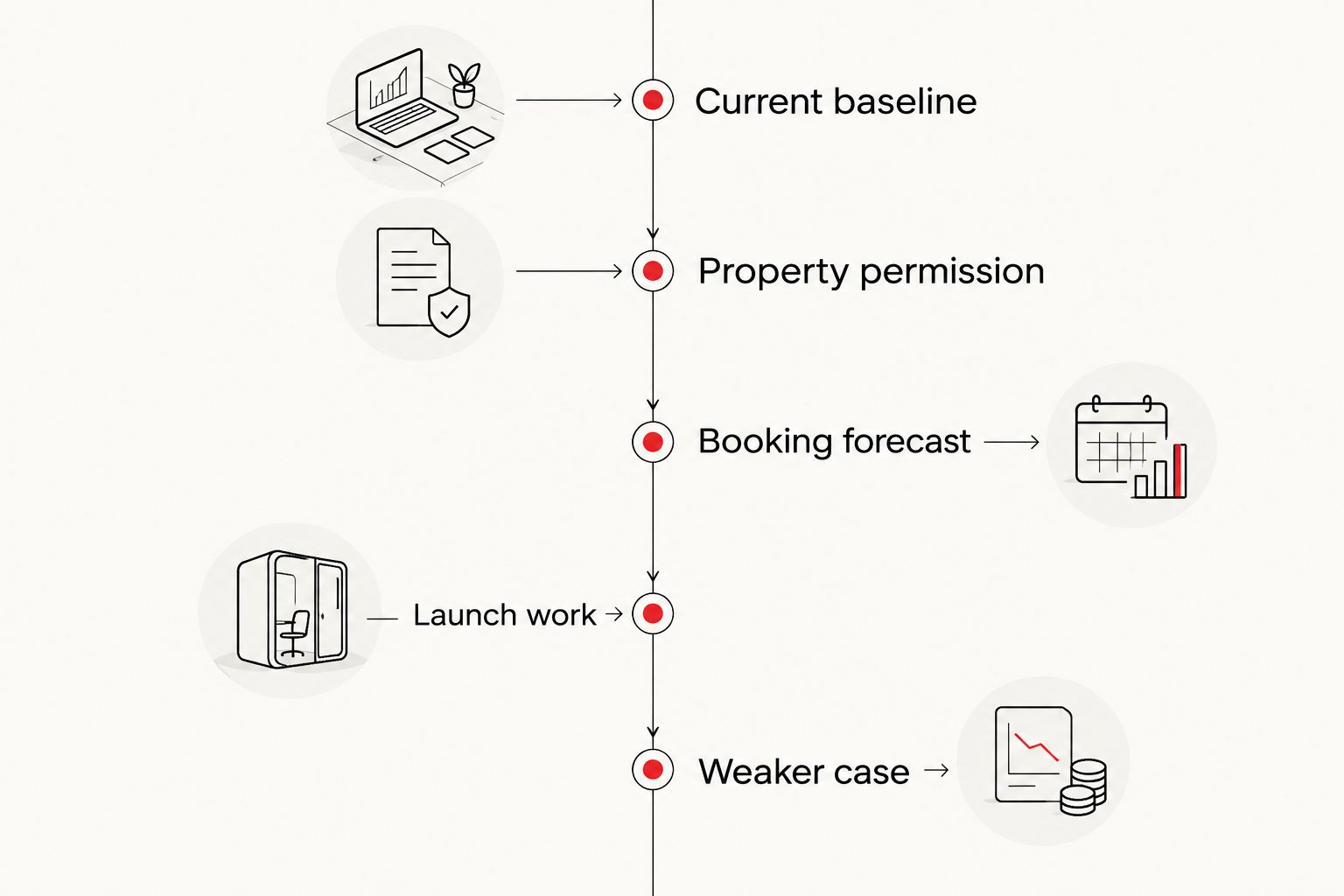
Confirm permission and test the economics before committing to the conversion.
Why the value of a Phoenix conversion varies
The same rental model does not produce the same result for every home. Your property's obligations and operating needs determine whether a higher revenue forecast becomes better owner income.
Property restrictions: Governing documents and address-specific requirements determine which uses you can pursue. Resolve these before evaluating guest demand.
Existing rental performance: A reliable tenancy with manageable expenses creates a different hurdle from a vacant property needing repairs.
Guest readiness: A furnished, maintained home requires a different transition plan from an unfurnished rental needing substantial preparation.
Owner-paid services: Utilities, supplies, turnover coordination, and booking administration change the expense structure when responsibility shifts to you.
Booking assumptions: Guest demand, cancellations, owner blocks, and unbooked periods affect what you collect across the operating year.
Management scope: A quoted management arrangement is only comparable when you know which services it includes and which remain your responsibility.
For your 2026 plan, assign each factor a document, an actual expense, or an explicit forecast assumption. Leave unsupported optimism out of the decision.
Is a higher nightly booking amount enough to justify switching?
Higher booking revenue is not enough to justify switching a Phoenix rental. The relevant improvement is what remains after the different expense structures and transition work are accounted for.
Compare revenue collected by the owner with revenue collected by the owner. Do not treat taxes collected for remittance or guest-paid service amounts as additional profit without tracing how those amounts move through the accounts.
Also separate property performance from personal tax outcomes. Ask a qualified tax professional to evaluate your circumstances instead of assuming that a different rental model automatically produces a particular tax result.
Can I convert while a long-term tenant still lives there?
An existing lease remains a separate obligation from your conversion plan. Review its terms and applicable law before setting a tenant departure date, entering the property for preparation, or accepting future reservations.
Build your launch schedule around lawful possession and the work that follows it. A marketing calendar does not replace a tenant transition plan.
If the tenancy is performing, assess the value of keeping it through its agreed term. Conversion timing is part of the investment decision, not just an administrative detail.
What happens if short-term bookings disappoint?
Your fallback needs to work before you convert, not after bookings disappoint. Decide whether you would continue operating, change the permitted rental format, or return to long-term leasing.
Each fallback needs its own expense review. Furnishings, storage, marketing changes, and another vacancy period do not disappear because you change direction.
Write down what would trigger a review and who would make the decision. Waiting indefinitely for better bookings is not an operating plan.
Account for guest operations, not just occupied nights
A short-term rental needs a service plan for the time between reservations as well as the time guests spend inside. Identify who handles access problems, cleaning checks, maintenance calls, guest communication, and exceptions to the normal schedule.
Guest screening belongs in that operating plan. Whether guest screening costs per booking sit inside a management agreement or appear separately changes how you compare proposals; screening also does not replace clear house rules, appropriate insurance, or a response process.
Ask what happens when a reservation changes after the home has been prepared. Establish who authorizes refunds, replacement supplies, emergency repairs, and additional cleaning rather than discovering the answer during a guest complaint.
For your 2026 operating plan, document these responsibilities alongside the forecast. A spreadsheet that assumes every reservation proceeds without interruption leaves out the work required to deliver the stay.
Decide whether management fits your ownership goals
Self-management keeps operating decisions with you, but it also leaves you responsible for arranging coverage. Paid management moves agreed responsibilities to a service provider; it does not remove the need to understand expenses, approve work, and review performance.
HomeSlice Stays is a fit for Scottsdale-area luxury homeowners seeking vacation rental management rather than self-management. Its stated services include luxury vacation rental property management and booking services for homeowners and travelers in Scottsdale and surrounding areas.
The fit still depends on the property and agreement. Review the actual service scope, exclusions, owner responsibilities, and reporting arrangements before treating any management proposal as part of your financial case.
Discuss your property's location and conversion goals with HomeSlice Stays, then evaluate the proposed arrangement against your existing rental baseline. Professional management is an operating choice—not evidence that conversion will produce better returns.
FAQ
Is switching a long-term rental to a short-term rental worth it in Phoenix in 2026?
Switching is worth it only when the property can legally operate and the expected owner cash flow justifies conversion work and operating risk. Compare a full operating year against your actual long-term rental performance.
Will an Airbnb automatically earn more than my Phoenix lease?
An Airbnb does not automatically produce more owner income than a Phoenix lease. Booking revenue must cover the property's operating expenses, unbooked periods, and transition burden before you have a meaningful comparison.
What should I check before furnishing a short-term rental?
Check property-use restrictions, current municipal requirements, insurance, lender terms, and existing lease obligations before furnishing. Establish that the intended use is permitted before committing to guest-ready preparation.
Should I compare monthly rent with nightly bookings?
Compare collected income after expenses across the same operating period, not monthly rent with an advertised nightly booking amount. Use consistent treatment of debt payments, owner use, and vacancy.
Can I keep using the home after converting it?
Personal use must fit around confirmed reservations and the operating rules that apply to your property. Include owner-blocked dates in the forecast rather than counting those dates as potential guest income.
Does professional management guarantee the switch will be profitable?
Professional management does not guarantee a profitable conversion. HomeSlice Stays provides luxury vacation rental management, but your decision still requires property-specific assumptions and a review of the proposed service agreement.
What is the strongest reason to keep my long-term rental?
Keep a performing long-term rental when the conversion case does not clearly justify its added work, expense, and uncertainty. A larger gross-revenue forecast alone is not a reason to replace an arrangement that meets your goals.
One last thing
The best time to reject a weak conversion is before the tenant leaves. Once you have bought furnishings and started preparation, those commitments can make an unconvincing forecast feel harder to question.
Write your decision in plain language: what the home earns now, what must change, what you expect to retain after expenses, and what would make you stop. If that explanation depends on uninterrupted bookings or expenses you have not checked, keep the lease-based baseline until the case improves.
Related guides
More Blogs