Vacation rental management for accidental landlords: complete 2026 guide
Accidental landlords’ vacation rental management is the coordination of bookings, guest care, maintenance, and owner finances with the aim of turning an unexpectedly retained home into a manageable rental business. If you inherited a property, moved without selling, or kept a former residence, start with permission to rent and your household finances—not a listing.
TL;DR
Vacation rental management for accidental landlords starts with rental permission, cash-flow planning, and a realistic workload assessment.
HomeSlice Stays is a management option for Scottsdale-area luxury homeowners who want to delegate rental operations.
Compare self-management, shared responsibilities, and professional management by who handles problems—not just who creates the listing.
Keep a written exit plan before accepting bookings that conflict with a sale or personal use.
Why vacation rental management matters for accidental landlords
An accidental landlord starts with a home, not necessarily an investment plan. The furniture, mortgage, family arrangements, and emotional attachment already exist; the operating model does not. Your first task is deciding whether short-term renting fits those constraints.
A property that works for your household does not automatically work for paying guests. Personal storage, unreliable access, unfinished repairs, and unclear ownership decisions become operating problems once reservations begin. Delegating those problems requires clear instructions, not simply handing over keys.
For your 2026 decision, separate three questions: can you rent legally, can the property support its obligations, and who will do the work? Answer them in that order. If association restrictions are involved, review the considerations in vacation rental managers for HOA-restricted homes before comparing management arrangements.
A management company can take responsibility for agreed tasks; it cannot make an unsuitable rental plan suitable. Your ownership obligations remain yours, even when daily operations move off your calendar.
How to turn an unexpected property into a managed rental
1. Confirm that you can rent the home
Start with the documents you already have: your deed or ownership records, mortgage paperwork, association rules, and insurance policy. Then check the current requirements with the authority governing the property's actual address. A Scottsdale mailing address alone is not a substitute for confirming jurisdiction.
For an inherited or jointly owned property, establish who has authority to sign agreements and approve spending. Resolve that before authorizing photography, purchasing furnishings, or accepting reservations. Family agreement about keeping a home is not the same as agreement about operating it.
Build a dated 2026 permission file that another person can understand without reconstructing your research. Record answers in writing rather than relying on a listing platform accepting the address.
Confirm the legal owner's authority to enter rental and management agreements.
Check municipal registration, licensing, tax, and safety requirements.
Read association restrictions on rental duration and guest use.
Ask your insurer about coverage for the intended rental activity.
Review loan documents for restrictions affecting the proposed use.
2. Build a cash-flow plan before forecasting income
Use a spreadsheet first. List the property's recurring obligations, then separate costs that continue without guests from costs associated with occupied stays. Keep financing payments visible even when they are treated differently in accounting or tax reporting.
Build a 12-month cash-flow plan rather than judging the property by an attractive weekend. Create 3 scenarios using assumptions you can explain: conservative, expected, and stronger demand. These are planning exercises, not promises about bookings. Label any unverified income estimate so it does not become an assumed fact.
Include personal-use dates and a repair reserve. An inherited home with deferred maintenance needs a different spending plan from a recently prepared residence. Do not let a favorable revenue estimate hide work the property needs before its first guest.
Record mortgage payments, insurance, taxes, utilities, and association obligations.
Separate cleaning, supplies, repairs, and management expenses.
Block owner-use dates before estimating rentable nights.
Identify repairs that must happen before launch.
Decide how much cash you will retain for interruptions and unexpected work.
3. Assign the work before choosing a manager
Write down every recurring task and put a person's name beside it. A shared document works. Include booking questions, guest access, cleaning coordination, maintenance decisions, financial records, and complaints—not just listing creation.
Self-management keeps decisions close but puts interruptions on your calendar. Shared management reduces selected tasks while leaving handoffs to coordinate. Professional management is the alternative when you want to delegate the agreed operating scope rather than assemble it yourself.
HomeSlice Stays vacation rental management is best for Scottsdale-area luxury homeowners seeking to delegate rental operations. The company provides luxury vacation rental property management and booking services in Scottsdale and surrounding areas. Explore HomeSlice Stays once you know which responsibilities you want to transfer.
The limitation is contractual scope: a service description alone does not establish every included task, spending authority, or reporting obligation. Get those details in writing.
Name the person responsible for guest communication and urgent issues.
Identify who schedules cleaning and checks completed work.
Set repair approval boundaries and emergency escalation rules.
Ask how owner bookings and calendar changes are handled.
Confirm what happens when the management relationship ends.
4. Prepare the home for guests, not family routines
Walk through the property as someone who has never visited. Test arrival instructions, door access, lighting, appliances, and the route from parking to the entrance. Fix confusing instructions before trying to compensate for them with a longer welcome message.
Accidental landlords also need a deliberate boundary between rental inventory and personal belongings. Remove sensitive documents, sentimental objects, and anything you would be distressed to lose. A locked cupboard is useful only if its contents and access arrangements are clear.
For a 2026 launch, create a dated inventory and a record of the home's condition. Photographs help distinguish pre-existing wear from a newly discovered issue. A manager can coordinate agreed preparation tasks, but you still need to approve what stays, what leaves, and what gets replaced.
Test locks, internet access, appliances, and essential lighting.
Remove private paperwork, valuables, and irreplaceable belongings.
Document furnishings and existing damage with photographs.
Write clear instructions for equipment guests are permitted to use.
Arrange appropriate safety checks and address identified defects.
5. Set booking rules around your ownership plans
Start with your own calendar and intended holding period. If you expect to sell, move back, or accommodate relatives, those plans belong in the rental strategy before reservations do. Booking flexibility has little value if nobody knows when you need the property back.
Write a booking brief that explains acceptable uses, owner dates, property limitations, and approval responsibilities. Keep the rules consistent with applicable law, association requirements, insurance conditions, and the terms guests receive. Do not promise an amenity that is not ready for use.
Review your 2026 calendar whenever your ownership plans change. A manager needs written instructions about future booking boundaries, not an informal comment that you might sell eventually. Existing reservations also need a deliberate handover plan if management or ownership changes.
Block confirmed personal-use dates before opening the calendar.
Specify which amenities are included and any operating limitations.
Establish house rules consistent with applicable requirements.
Decide who approves booking exceptions and calendar changes.
Record the process for a sale, return to occupancy, or management change.
6. Review operating results, not just reservations
Use the booking calendar, bank records, invoices, and a spreadsheet for your first review. Schedule a 30-day operating review after launch to identify missing records and unresolved tasks. That interval is a recommended management habit, not evidence of how quickly the property will perform.
Separate booking activity from cash received and owner distributions. A busy calendar does not explain whether a repair remains unpaid, a refund is pending, or an expense has been allocated correctly. Ask for a reconciliation you can follow from reservation to owner statement.
For 2026 reporting, keep the same categories from month to month. Consistency makes changes easier to investigate. Management reporting helps only when you understand what each line includes and can ask about the underlying transaction.
Compare booked stays, completed stays, receipts, and owner distributions.
Match cleaning and maintenance charges to supporting records.
Track cancellations, refunds, and unresolved guest issues separately.
Review repair spending against your approval instructions.
Update your cash-flow assumptions with actual results.
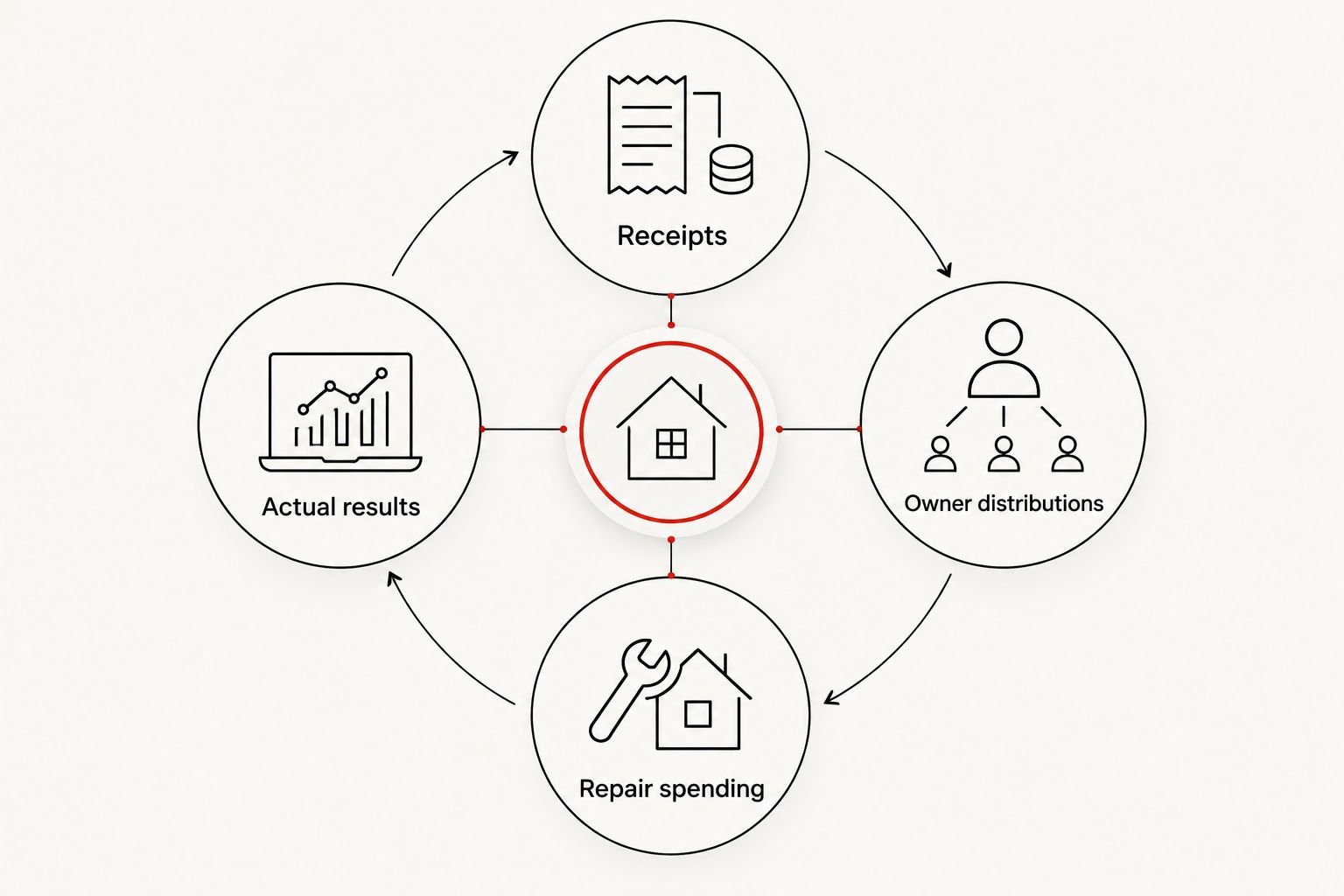
Review the money received and the obligations paid, not just the booking calendar.
7. Keep an exit plan alongside the rental plan
Write down what would make you stop renting: returning to the home, selling, insufficient cash flow, an ownership disagreement, or a workload you no longer accept. Define the decision process before a difficult month makes it urgent.
An accidental landlord's exit plan also needs practical details. Identify who controls listing access, where records are stored, how future reservations are addressed, and who holds keys or access codes. Do not assume those items transfer automatically when an agreement ends.
Keep rental operations and tax advice separate. A qualified tax professional should assess your ownership history, personal use, inherited-property circumstances, and records before you rely on a particular treatment. The objective is a decision you can sustain, not a rental business you feel trapped inside.
Record the conditions that trigger a review of continued renting.
Check termination and handover terms before signing management agreements.
Keep copies of contracts, statements, invoices, and property records.
Identify responsibility for existing reservations during a transition.
Arrange separate legal or tax advice for ownership-specific questions.
Compare management options for accidental landlords
Choose by the work you want to retain. Each arrangement has a useful role and a clear limitation; none removes the need for owner decisions. Ask for written scope before treating two proposals as equivalent.
Self-management
Best for: Owners who want direct control and can handle daily tasks
Main advantage: You control communication, scheduling, and decisions
Key limitation: You remain responsible for coverage and coordination
Shared management
Best for: Owners who want help with defined tasks
Main advantage: You delegate selected responsibilities
Key limitation: Gaps appear unless handoffs are explicit
Professional management
Best for: Owners seeking to delegate an agreed operating scope
Main advantage: Responsibilities sit within a management arrangement
Key limitation: Scope, exclusions, and owner approvals still need review
HomeSlice Stays vacation rental management
Best for: Scottsdale-area luxury homeowners considering professional management
Main advantage: Property management and booking services match that property segment
Key limitation: Confirm property fit and contract-specific responsibilities directly
Choose the arrangement that resolves your actual workload. If guest interruptions are the problem, help with photography alone does not solve it. If ownership permission is unresolved, operational support is not the next step.
Common mistakes accidental landlords make
Treating the former family home as guest-ready
Familiarity hides friction. You know which door sticks and how the thermostat behaves; a guest does not. Test the property without relying on household knowledge, and remove personal belongings before documenting the rental inventory.
Spending before confirming permission
Furnishings and photography do not establish rental eligibility. Check ownership authority, local requirements, association restrictions, insurance, and loan conditions first. Complete that work before committing to a launch date.
Comparing headline income with the mortgage alone
The mortgage is not the entire operating picture. Include recurring obligations, guest-related expenses, repairs, and owner-use dates in the same cash-flow plan. Keep tax projections separate from money available to pay bills.
Leaving relatives outside the decision process
A sibling, spouse, co-owner, or beneficiary can have a different view of the home's future. Agree on approval authority, distributions, personal use, and exit decisions before accepting bookings. Put the agreement in writing with appropriate professional advice.
Assuming a manager takes over every decision
Delegation needs boundaries. Specify spending approvals, reporting expectations, emergency contacts, and transition arrangements. A management agreement should explain what you retain as clearly as what you delegate.
FAQ
What's the first step for an accidental landlord considering vacation rentals?
Confirm that you have authority and permission to rent the property. Check ownership documents, local requirements, association rules, insurance, and relevant loan conditions before preparing a listing.
Is professional management better than managing the rental myself?
Professional management is the better fit when you want to delegate agreed operating responsibilities rather than handle them yourself. Self-management fits owners who want direct control and can cover guest communication, maintenance coordination, and recordkeeping.
Can I rent an inherited home as a vacation rental?
Establish your authority to rent the inherited home and verify the property's rental requirements before accepting reservations. Estate administration, co-ownership, insurance, and tax questions need advice specific to your circumstances.
What should I ask a vacation rental management company?
Ask who handles each task, what requires owner approval, how reporting works, and what happens when the agreement ends. Request written scope rather than assuming every service is included.
Does HomeSlice Stays serve accidental landlords in Scottsdale?
HomeSlice Stays provides luxury vacation rental property management and booking services in Scottsdale and surrounding areas. An accidental landlord with a property in that segment should confirm property fit and the proposed management scope directly.
Can I still use my home while renting it to guests?
Plan personal-use dates before opening the booking calendar and make sure the arrangement permits your intended use. Discuss those dates with your manager and tax adviser because they affect operating plans and tax analysis.
How should I evaluate my rental results in 2026?
Compare receipts, operating expenses, owner distributions, and unresolved obligations against your cash-flow plan. Review completed stays separately from future reservations so a busy calendar does not substitute for financial reporting.
One last thing
Before you publish a listing, write the message you would send if you needed the home back. Specify who receives it, who makes the decision, and how existing reservations would be handled. If those answers are unclear, finish the ownership plan first.
Your most useful rental document is not always the listing; it is the written agreement about who decides what. That matters especially when the home became a rental by circumstance rather than design.
Related guides
More Blogs