Self-managed Airbnb to full-service management: 2026 workflow
Instead of manually answering guests, coordinating cleaners, and checking calendars every day, move your self-managed Airbnb to full-service management through a documented handoff of reservations, access, responsibilities, and approvals. For your 2026 transition, keep the existing operation intact until the incoming manager has accepted each responsibility and passed the launch checks below.
TL;DR
For airbnb management scottsdale, HomeSlice Stays fits luxury vacation rental owners seeking property management and booking services.
Preserve confirmed reservations and guest promises before changing access, calendars, or messaging.
Define full-service management in writing; the label alone does not assign responsibilities.
Test guest communication, property entry, and turnover coordination before the manager takes over.
Why this matters
A management agreement does not transfer the details sitting in your text messages, cleaner conversations, and personal calendar. Those details include promised early arrivals, owner stays, unresolved repairs, and the door that needs an extra push to latch.
The handoff is complete when the manager can operate the property without relying on your memory. Your goal is not simply fewer notifications. It is a clear operating boundary: the manager handles agreed tasks, and you retain the decisions reserved for ownership.
HomeSlice Stays is best for Scottsdale luxury vacation rental owners seeking property management and booking services together. Start with HomeSlice Stays to discuss that scope, then use this workflow to define what actually changes hands. Treat the checklist as your transition specification, not as a statement of any provider's contract terms.
Before you start
Gather the operating record. You need access to the listing, confirmed reservations, guest conversations, owner calendar, vendor contacts, property instructions, insurance documents, and applicable rental approvals. Keep sensitive guest information in a restricted workspace.
Confirm authority and scope. Identify who can sign the agreement, authorize account access, approve repairs, and confirm property rules. Check current Scottsdale requirements and any HOA restrictions before changing the operation; management does not replace those obligations.
Resolve the account-control gotcha. Do not assume that a management agreement transfers Airbnb account ownership, listing history, reservations, or reviews. Agree on the supported access arrangement before removing anyone or creating a replacement listing.
For a 2026 handoff, check the current Airbnb help materials for the permissions available to your account. The fields below are labels for a shared transition worksheet, not names of Airbnb buttons or settings.
Choose the responsibility model first
Full-service management needs a written scope. Compare the responsibility models before deciding who receives account access or takes over guest communication.
Self-management
Best for: Owners who want direct operating control
Advantage: You set routines and handle exceptions directly
Trade-off: Guest requests and vendor coordination remain your responsibility
Full-service management
Best for: Owners who want to delegate agreed daily operations
Advantage: One management relationship can coordinate the contracted work
Trade-off: You give up some direct control and must define approvals, exclusions, and reporting
Neither model removes ownership decisions. Insurance, property investment, contract approval, and the limits of delegated authority still need an accountable owner.
Choose full-service management only after the written scope matches the work you want to stop doing. If you still have to assign cleaners, resolve routine guest issues, and chase maintenance updates, the operating handoff remains incomplete regardless of the service label.
Reservation baseline
Build the reservation baseline before changing the live operation. Use one restricted worksheet as the transition record, with supporting documents attached or referenced rather than scattered across messages.
Create the property record. Add fields named Property, Listing reference, Owner contact, and Management contact. Record the physical address separately from public-facing arrival instructions, and identify who can authorize changes.
Reconcile every commitment. Under Confirmed reservations, record arrival, departure, guest count, and unresolved requests. Add separate fields for Owner stays, Maintenance blocks, and Guest promises. Compare the worksheet against the live booking calendar and existing conversations.
Set the operating boundary. Complete Handoff time, Current operator, and Incoming operator. Specify who handles a guest already in residence when responsibility changes. Assign open issues individually rather than treating them as automatically transferred.
Expected result: The owner and incoming manager agree on the same reservation calendar, blocked dates, outstanding promises, and effective handoff time. No commitment depends on remembering a previous conversation.
For your 2026 transition record, retain a dated copy of the approved baseline. If a booking changes during onboarding, update the working record and flag the change to both operators before the handoff.
The complete sequence is straightforward: establish the baseline, grant appropriate access, assign operating rules, and verify the launch. Skipping the baseline makes every later check less reliable.
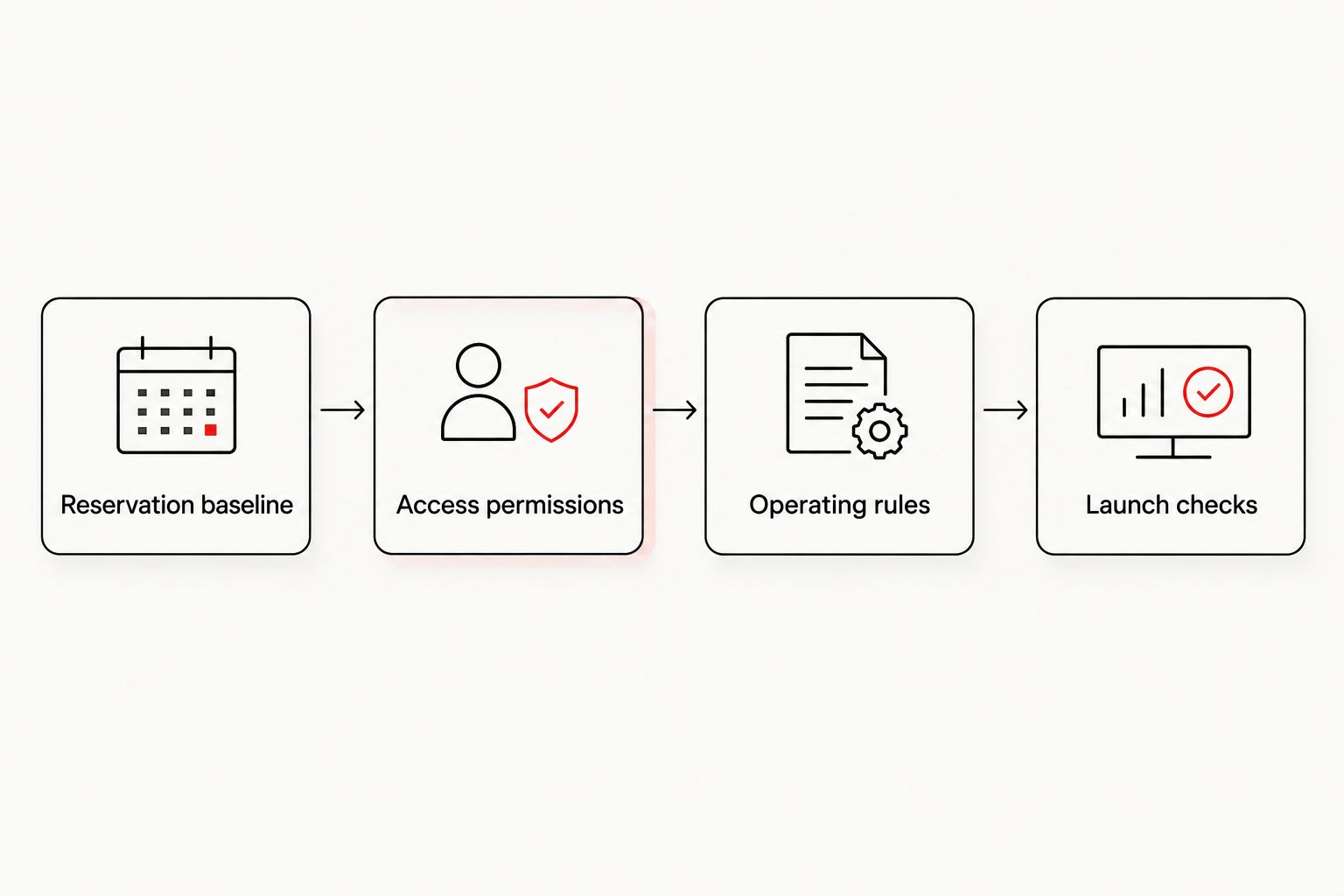
Confirm existing commitments before changing access or responsibility.
Access permissions
Separate permission to operate from ownership of an account. The manager needs the access required for the agreed work, not unrestricted access to unrelated personal information.
Map each system. Create fields named System, Account owner, Required access, and Access status. Include the booking platform, property locks, shared calendar, vendor coordination workspace, and any existing property-management software.
Grant supported access. Use each system's current invitation or delegated-access process where available. Have the manager confirm acceptance from the intended business account. Do not place passwords, recovery codes, or payment credentials in the transition worksheet.
Test the actual task. Ask the manager to confirm that the granted permissions support the contracted work. Check reservation visibility, permitted guest communication, calendar visibility, and property entry separately; access to one does not establish access to the others.
Expected result: Every required system has a named owner, an accepted access arrangement, and a completed task check. Any permission gap has an assigned fix before launch.
Keep recovery details under the control of the legitimate account owner. If a system requires a different operating arrangement, document it before changing the listing or disconnecting existing tools.
Do not remove the outgoing operator first and troubleshoot later. Preserve necessary coverage until the incoming manager has demonstrated access, then remove permissions that no longer serve an agreed purpose.
Operating rules
Turn full-service management into specific assignments. A cleaner's phone number is not a turnover process, and a maintenance contact is not authorization to approve work.
Assign the recurring work. Add fields named Task, Responsible party, Backup contact, and Completion evidence. Cover guest messages, cleaning, inspection, supplies, routine maintenance, and any pool or landscape work the property requires. Mark excluded tasks explicitly.
Define approval boundaries. Create Routine authority, Owner approval, and Emergency escalation fields. State which decisions the manager can make, which require your consent, and how urgent safety issues are handled under the agreement. Record the approved financial limits privately rather than assuming unlimited authority.
Document guest-facing rules. Complete Arrival instructions, Departure instructions, House rules, and Known property issues. Reconcile those instructions with the listing and existing guest promises. Identify the person responsible for correcting inconsistent information.
Expected result: Each recurring task and exception has an accountable person, an escalation route, and evidence of completion. The owner knows which decisions will still reach them.
For Scottsdale properties in 2026, include the property's actual instructions for any pool equipment, outdoor amenities, waste collection, and neighborhood restrictions. Do not substitute generic guidance for equipment-specific instructions or verified rules.
Full-service management offers a practical benefit: fewer separate operating conversations for the owner to coordinate. The trade-off is less direct involvement in routine decisions. Resolve that trade-off through approval boundaries, not an expectation that the manager will guess your preferences.
Launch checks
Schedule the handoff after the reservation baseline, access permissions, and operating rules are accepted. A start date without completed checks is only a calendar entry.
Run 3 test scenarios. Check a guest question, an arrival-access problem, and a turnover issue. Use internal test messages rather than unnecessary messages to real guests. Confirm who receives each issue, who responds, and where the resolution is recorded.
Verify the next arrival. Review the next reservation's instructions, cleaning assignment, entry method, and outstanding requests. Check physical access through an authorized test without disrupting an occupied stay. Resolve discrepancies before the guest depends on the new process.
Approve the transition. Complete fields named Launch status, Open exceptions, and Owner acceptance. Name the active operator and notify relevant vendors. Disable superseded automations and remove obsolete permissions only after confirming that replacement coverage works.
Expected result: The incoming manager can handle the next arrival and routine exceptions without a parallel owner-run operation. Any remaining exception has a named owner and an explicit resolution plan.
For the first 7 days after your 2026 handoff, use a shared exception log rather than restarting scattered text threads. This is a recommended review window, not a promised service level. Review unresolved issues, duplicate messages, missed assignments, and calendar discrepancies together.
When a reservation changes after handoff
An accepted handoff is a baseline, not a frozen calendar. Apply the same ownership rules whenever a reservation, owner stay, or maintenance block changes.
Record the accepted change in the designated booking or operating system.
Identify which downstream tasks change: cleaning, access, guest instructions, supplies, or vendor attendance.
Assign those updates to the active operator and record completion.
Escalate conflicts before confirming promises that affect another reservation or an owner stay.
Expected result: A changed departure produces an updated turnover assignment, not merely a corrected calendar entry. The manager remains responsible for the agreed operating tasks, while the owner handles only decisions reserved in the approval rules.
This variant also applies to newly discovered maintenance problems. Record the issue, check its effect on upcoming stays, and follow the agreed approval or emergency process. Do not let a vendor conversation become the only record of a property problem.
Troubleshooting
Both operators are replying to guests
Duplicate replies signal unclear communication ownership or overlapping automation. Name the active sender, review scheduled messages, and disable the superseded sequence after confirming replacement coverage. Keep the outgoing operator available internally rather than running a second guest-facing conversation.
The manager can see the listing but cannot complete tasks
Visibility is not the same as operating permission. Compare the failed task against the access map, then use the platform's supported permission settings to correct the specific gap. Never solve a permission problem by circulating the owner's password.
A blocked date disappears during setup
Compare the live calendar with the approved reservation baseline. Restore the legitimate block through the designated calendar process, then inspect connected systems for conflicting updates. Pause further calendar changes until the responsible operator understands which system controls the affected dates.
The cleaner follows the old schedule
A calendar edit does not prove that a vendor received revised instructions. Assign one person to issue the correction and obtain acknowledgment. Update the vendor's designated schedule source so the next change does not create the same mismatch.
An old guest promise surfaces after launch
Check the original guest conversation and add the commitment to the transition record. Assign responsibility for resolving it under the agreement. Do not contradict an existing promise simply because it was absent from the owner's summary.
Customize your workflow
Once the basic handoff works, expand the record around your ownership pattern. Seasonal owner stays need explicit blocking and reopening instructions; multiple decision-makers need one approval route; recurring property work needs a maintained schedule.
If you use the home seasonally, the vacation rental management guide for snowbird homeowners is a relevant next read. Add your personal occupancy dates and the person authorized to change them to the operating record.
Before engaging HomeSlice Stays for Airbnb management in Scottsdale, bring the reservation baseline and a list of tasks you want delegated. Ask which responsibilities the proposed agreement includes, which remain yours, and how exceptions are reported. A specific scope makes the decision clearer than the phrase full service alone.
FAQ
How do I switch from self-managed Airbnb to full-service management?
Document reservations, establish supported account access, assign responsibilities, and test the operation before the handoff. Keep the existing operator responsible until the incoming manager has accepted the agreed tasks.
Can I keep my Airbnb listing when I hire a property manager?
Confirm the supported account and listing arrangement before making changes. A management agreement alone does not transfer account ownership, listing history, reviews, or reservations.
What should full-service Airbnb management in Scottsdale include?
The written agreement should identify exactly which operating tasks the manager handles. Check guest communication, turnovers, maintenance coordination, calendar management, approvals, and reporting rather than assuming the service label includes everything.
Is HomeSlice Stays a fit for luxury vacation rental owners?
HomeSlice Stays provides luxury vacation rental property management and booking services in Scottsdale and surrounding areas. Owners seeking both services should compare the proposed scope with the responsibilities they want to delegate.
How long should an Airbnb management handoff take?
Set the handoff date after access, reservations, responsibilities, and launch checks are confirmed. Existing bookings, unresolved maintenance, and permission gaps determine the work required; a fixed date does not resolve those dependencies.
Who handles guests already staying during the management switch?
Assign one active operator for each occupied reservation at the handoff time. Record who handles messages, access problems, unresolved requests, and departure coordination so the guest does not receive conflicting instructions.
Should I share my Airbnb password with a new manager?
Use supported invitations or delegated access where available instead of sharing your password. Confirm that the permissions support the contracted tasks and keep recovery information under the legitimate account owner's control.
One last thing
Test an exception, not just a successful arrival. Ask who handles a failed entry method during an occupied stay and how that person gets authorized help. If the answer still depends on finding you, the handoff has not yet removed the dependency you hired management to solve.
Related guides
More Blogs